The So-Called “Rival Poet” of the Sonnets is NOT A REAL PERSON….

A section of the Shakespeare sonnets (78 to 86) has been known traditionally as the Rival Poet Series.  Stratfordians and anti-Stratfordians alike, including most Oxfordians, still assume that this figure must be a real individual such as George Chapman or Walter Raleigh or Robert Devereux, Earl of Essex.  Well, I suggest this demonstrates yet again the power of a prior assumption or a long-held belief that is taken for granted and never questioned.

The Dedication of "Lucrece" - 1594 - CLICK ON IMAGE FOR LARGER VIEW

The idea of the Rival Poet is that another writer has competed with the author successfully for the affections of the younger man known as the Fair Youth –  identified as Henry Wriothesley, Earl of Southampton (1573-1624), to whom “William Shakespeare” dedicated his first printed works, Venus and Adonis of 1593 and Lucrece of 1594, pledging: “The love I dedicate to your Lordship is without end … What I have done is yours, what I have to do is yours, being part in all I have, devoted yours.”

Never again would the great author dedicate anything to anyone else, ensuring that the names of Southampton and Shakespeare would be linked exclusively and forever.  In Sonnet 82 of the Rival Poet series, the author points directly to his public epistles to Southampton, referring to:

The dedicated words which writers use

Of their fair subject, blessing every book

Under the belief that William Shakspere of Stratford was the author,  it’s a given that the Rival Poet must be a real human being.  But once Edward de Vere, Earl of Oxford is postulated as the author known as “Shakespeare,” it’s not only possible but inevitable that the Rival Poet is none other than his pen name or public persona, which is getting all the attention as the writer linked to Southampton.

As mentioned above, most of my own colleagues, while convinced that Edward de Vere was the great author, still assume that the Rival Poet is a real person.  [The latest candidate of choice is the Earl of Essex.]  Yet the case for Oxford is based on the premise that in fact he’s living with a split personality!  This is seen clearly in the personal sonnets, where he himself is PRIVATELY writing to Southampton while his alter ego “Shakespeare” is PUBLICLY addressing him (in the dedications still being printed in new editions of the narrative poems).

Dedication of "Venus and Adonis" - 1593

I wish my Oxfordian colleagues could entertain the thought that the “authorship question” is answered right there in the Sonnets — which Edward de Vere wrote and later compiled as a “monument” to preserve for posterity his own testimony about why and how he chose to obliterate his identity behind the “Shakespeare” mask.  What he describes in the Sonnets is NOT merely the adoption of the pen name in the early 1590’s, in which case he could have expected to be revealed posthumously, but, rather, his decision to sacrifice his identity after his death:

“My name be buried where my body is,” he writes in Sonnet 72, leading up to the “rival” series.

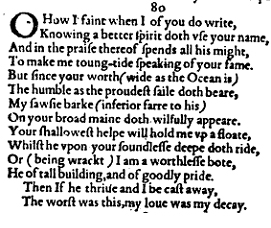
Oxford, addressing Southampton in Sonnet 80, offers a capsule answer to the authorship question:

O how I faint when I of you do write,

Knowing a better spirit doth use your name,

And in the praise thereof spends all his might

To make me tongue-tied speaking of your name.

The pen name “Shakespeare” is the rival who can praise Henry Wriothesley in public, while Edward de Vere must remain “tongue-tied” or silent.  (In Sonnet 66 he complains that his “art” or ability to communicate has been “tongue-tied by authority” or by official policy.)

"Knowing a better spirit doth use your name"

Would the Earl of Oxford, Lord Great Chamberlain of England and highest-ranking earl of the realm, ever, under any circumstances, call anyone else, including Chapman or Raleigh or Essex (whom he really disliked), a “better spirit”?  I think not!

“Shakespeare” is the better spirit… 

In Sonnet 81 he offers an even more direct answer, telling Southampton:

Your name from hence immortal life shall have

Though I (once gone) to all the world must die

Could that be any clearer?  He correctly predicts that Southampton will be remembered because of the Shakespeare connection; and then he says directly that, after his death, he will have to “die” all over again “to all the world”which can only mean that he anticipates his own obliteration as “Shakespeare,” who publicly devoted his labors to Southampton.

By what logic, and for what reason, would the traditional Shakespeare write such words?

This is just one piece of the puzzle among others needed to create the full picture.  I’ll be back with more such pieces, as set forth in The Monument … in Shakespeare’s Son and His Sonnets … and in Twelve Years in the Life of Shakespeare.

Happy New Year 2012 from “The Monument” and “Shakesepeare’s Son and His Sonnets”

"The Monument" at Amazon.com

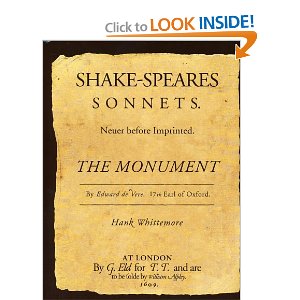
Happy New Year!  Thanks to all readers of this blog and to all who join us in the effort to break down the walls of denial about the true Shakespeare.  We are pleased to report that The Monument: “Shake-speare’s Sonnets” by Edward de Vere 17th Earl of Oxford is entering its eighth year of publication and continues as strongly as ever to communicate with readers in the U.S. and around the world.

"The Monument" on Kindle

And we are especially pleased to be reaching new readers of The Monument on Kindle, which includes the entire book of 900+ pages in its original format.  The same is true for our “overview” or “synopsis” version entitled Shake-Speare’s Son and His Sonnetsa title that indicates, in no uncertain terms, where we stand on the most controversial issue in the Oxfordian community — Prince Tudor!

"Shakespeare's Son and His Sonnets" at Amazon.com

Here’s a quick response I gave this morning to a reader of this blog who, in the comments section, asked about the Shakespeare Authorship Question as a conspiracy theory.  I told it as I see it:

“The traditional belief that ‘Shakespeare’ was a man from Stratford upon Avon is a powerful myth, which for many makes it difficult if not impossible to look at the facts clearly and without the tremendous pull of prior assumptions. A common attack on those who search for the truth is that they must be “snobs” who feel a commoner could not have written the great poems and plays; but the real snobs are those in academia who continue to ridicule and scoff as well as attack. If there is a conspiracy theory afoot, it’s the conspiracy of powerful entities such as the Shakespeare Birthplace Trust and the British tourism industry based on Stratford, along with the world of academia that includes educational institutions, academic credentials, peer-review publishing, teaching tools, textbook companies, the publishing and entertainment worlds — all working together to help each other continue making profits and staying in business. A lot is at stake. Follow the money.

“In the history itself, in my view, the only explanation for an attempt to deceive is that there existed a Prince Tudor — a possible heir by blood to the throne of England in succession to Elizabeth Tudor, the First Elizabeth and legendary Virgin Queen — who, if ‘Shakespeare’ was telling the truth in the Sonnets, was the son of Elizabeth and Edward de Vere, Earl of Oxford, raised as Henry Wriothesley, third Earl of Southampton, to whom ‘Shakespeare’ dedicated his work and for whom he created the Sonnets as a means of preserving the truth for posterity. It’s all right in front of us, just like so many other things in our lives that are standing in plain sight but go unacknowledged…”

I would add that there’s no other credible explanation for long-term concealment of the true author of the greatest works written in the English language or possibly in any language.  The works attributed to “Shakespeare” — the plays, yes, but especially the poems and sonnets — are the living containers of true history; and if the Earl of Oxford had been revealed as the author, it would not have taken long for the existence of a Prince Tudor — a Tudor heir — to become known and to ignite a new civil war around the throne.  There could have been no higher stakes for those in power and, too, for the stability of a nation.

Once again — Happy New Year to all!

Reason No. 28 of 100 to Believe that Edward de Vere, the 17th Earl of Oxford was “Shakespeare”: the Crucial Role Played by Henry Wriothesley, the 3rd Earl of Southampton, Dedicatee of Shakespeare’s Poetry and Fair Youth of his Sonnets

One of the most important reasons to believe Edward de Vere the seventeenth Earl of Oxford was “Shakespeare” – number 28 on this list – is the central role played by Henry Wriothesley the third Earl of Southampton.

Henry Earl of Southampton in his teens, by Nicholas Hilliard

The grand entrance of “William Shakespeare” onto the published page took place in 1593 as the printed signature on the dedication to Southampton of Venus and Adonis as “the first heir of my invention,”  followed a year later by the dedication to him of Lucrece in 1594, with an extraordinary declaration of personal commitment to the 20-year-old earl:

“The love I dedicate to your Lordship is without end … What I have done is yours, what I have to do is yours, being part in all I have, devoted yours … Your Lordship’s in all duty, William Shakespeare.”

“There is no other dedication like this in Elizabethan literature,” Nichol Smith wrote in 1916, and because the great author never dedicated another work to anyone else, he uniquely linked Southampton to “Shakespeare” from then to now.

Southampton at 22 in 1595

Most scholars agree that “Shakespeare,” in the first seventeen of the 154 consecutively numbered sonnets printed in 1609, was privately urging Southampton to beget a child to continue his bloodline – demanding it in a way that would ordinarily have been highly offensive: “Make thee another self, for love of me.”

[As most readers of this blog are aware, I believe the language, tone and statements in the Sonnets make clear beyond a reasonable doubt that the elder poet, Oxford, was writing to Southampton as father to son – and, too, as father to a royal son who deserved to succeed his mother, Queen Elizabeth, on the throne as King Henry IX of England.  For the purposes of this post, however, all we need show is that Oxford is the most likely man who publicly pledged his devotion to Southampton.]

The trouble for traditional scholars is that there’s not a scrap of documentary evidence that “Shakespeare” and Henry Wriothesley had even met each other, much less that they might have had any kind of personal relationship allowing the author to command a high-ranking peer of the realm to “make thee another self, for love of me”!

“It is certain that the Earl of Southampton and the poet we know as Shakespeare were on intimate terms,” Charlton Ogburn Jr. wrote in The Mysterious William Shakespeare [1584], “but Charlotte G. Stopes, Southampton’s pioneer biographer [1922] spent seven years or more combing the records of the Earl and his family without turning up a single indication that the fashionable young lord had ever had any contact with a Shakespeare, and for that reason deemed the great work of her life a failure.”

“Oxford was a nobleman of the same high rank as Southampton and just a generation older,” J. Thomas Looney wrote in 1920, adding that “the peculiar circumstances of the youth to whom the Sonnets were addressed were strikingly analogous to his own.”

William Cecil Lord Burghley, Master of the Royal Wards

  • Edward de Vere became the first royal ward of Elizabeth at age twelve in 1562, under the guardianship of William Cecil (later Lord Burghley), and in 1571 he entered into an arranged marriage with the chief minister’s fifteen-year-old daughter, Anne Cecil.
  • Henry Wriothesley became the eighth and last such child of state as a boy in 1581, also in the chief minister’s custody, and during 1590-91 he resisted unusual pressure to enter into an arranged marriage with Burghley’s fifteen-year-old granddaughter, Elizabeth Vere.

The young lady was also Oxford’s daughter (of record), making him in fact the prospective father-in-law; and scholars generally agree that in the “procreation” sonnets Shakespeare sounds very much like a prospective father-in-law (or father) urging Southampton to accept Burghley’s choice of a wife for him.

Lady Elizabeth Vere, who married William Stanley Earl of Derby in 1595

At the outset, therefore, Edward de Vere and Henry Wriothesley were brought together by this particular marriage proposal coming from the most powerful man in England with the full blessing of his sovereign mistress.  And regardless of how either Oxford or Southampton truly felt about it, they both had an extremely important personal stake in the outcome.

Looney noted that both Oxford and Southampton “had been left orphans and royal wards at an early age, both had been brought up under the same guardian, both had the same kind of literary tastes and interests, and later the young man followed exactly the same course as the elder as a patron of literature and drama.”

The separate entries for Oxford and Southampton in the Dictionary of National Biography, written before the twentieth century, revealed that “in many of its leading features the life of the younger man is a reproduction of the life of the elder,” Looney noted, adding it was “difficult to resist the feeling that Wriothesley had made a hero of De Vere, and had attempted to model his life on that of his predecessor as royal ward.”

If Oxford was writing the private sonnets to Southampton, and I have no doubt of it, then we should not expect to find the two of them publicly spending much time together or even any time at all.  Oxford tells Southampton in Sonnet 36, for example, “I may not evermore acknowledge thee;” in Sonnet 71 he instructs him, “Do not so much as my poor name rehearse;” and in Sonnet 89 he vows: “I will acquaintance strangle and look strange, Be absent from thy walks, and in my tongue Thy sweet beloved name no more shall dwell…”

A Notice of the Essex-Southampton Trial of Feb. 19, 1600 (1601) with Edward de Vere given prominence as a judge on the tribunal

[Once Southampton came to Court at age sixteen or seventeen, Oxford removed himself from active attendance.  The two shared an important secret, a hidden story, that tied them together; and they evidently needed to stay apart, at least in public.]

Some of the historical facts are:

  •    As royal wards, both Oxford and Southampton had Queen Elizabeth as their official mother, in addition to serving her as loyal subjects.
  •    Oxford in the early 1590’s was Southampton’s prospective father-in-law.
  •    After the failed Essex Rebellion in February 1601, Oxford came forth to sit as highest-ranking earl on the tribunal for the treason trial of Essex and Southampton.
  •    The peers had no choice but to render a unanimous guilty verdict; but there is evidence that Oxford then worked behind the scenes to save Southampton’s life and gain his eventual liberation, as in Sonnet 35: “Thy adverse party is thy Advocate.”
  • Southampton in the Tower (Feb 8, 1601 - April 10, 1603)

  • On the night of Oxford’s reported death on June 24, 1604, agents of the Crown arrested Southampton and returned him to the Tower, where he was interrogated all night until his release the following day.
  • Henry de Vere, 18th earl of Oxford, and Henry Wriothesley, 3rd earl of Southampton - circa 1619

  • Henry Wriothesley Earl of Southampton and Henry de Vere, the eighteenth Earl of Oxford+ became close friends during the reign of James; the earls were known as the “Two Henries.”  They were Parliament men who often took sides against the king and were imprisoned for it.

(Henry de Vere was born to Edward de Vere and his second wife Elizabeth Trentham in February 1593)

And there are other kinds of evidence for us to mull:

Tradition has it that Shakespeare wrote Love’s Labour’s Lost in the early 1590’s for Southampton to entertain college friends at his country house; but given the sophisticated wordplay of this court comedy and its intended aristocratic audience, it is difficult to see how Will of Stratford would or could have written it.

On the eve of the Essex Rebellion led by the Earls of Essex and Southampton, some of the conspirators engaged the Lord Chamberlain’s Company to perform Shakespeare’s play Richard II at the Globe; and a number of historians assume, perhaps correctly, that Southampton himself got permission from “Shakespeare” to use the play with its (as yet unpublished) scene of the deposing of the king.

Once the so-called rebellion failed and Southampton was imprisoned in the Tower on that night of February 8, 1601, all authorized printings of heretofore unpublished Shakespeare plays abruptly ceased.

After Southampton was released on April 10, 1603, the poet “Shake-speare” wrote Sonnet 107 celebrating his liberation after being “supposed as forfeit to a confined doom,” that is, subjected to a “doom” or sentence of imprisonment for life.

The White Tower where Southampton was imprisoned

When Oxford reportedly died in June 1604, a complete text of Hamlet was published; and then all such authorized publications again ceased for the next nineteen years until the First Folio of Shakespeare plays in 1623.

For the wedding of Philip Herbert, Earl of Montgomery and Oxford’s daughter Susan Vere in December of 1604, the Court of James held a veritable Shakespeare festival with seven performances of the Bard’s plays running into January 1605.  [If Edward de Vere had been the real author, and again I have no doubt that he was, the royal performances were a memorial tribute to him.] One of the festival’s stagings for King James and Queen Anne, with the Court, was a revival of Love’s Labour’s Lost, hosted by Southampton at his house in London.

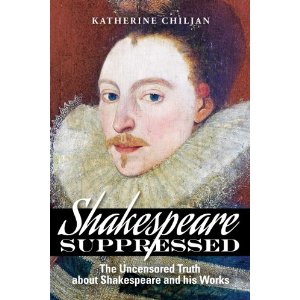
“Shakespeare Suppressed” by Katherine Chiljan — New Revelations about the Earl of Essex, King James and the Earl of Southampton

Katherine Chiljan in her new book Shakespeare Suppressed: The Uncensored Truth about Shakespeare and his Works (Faire Editions: San Francisco: 2011) puts forth striking evidence about the relationship of Robert Devereux, second Earl of Essex and King James  – documents that may be new to most researchers until now.  “Evidence shows that Essex did not wish King James VI of Scotland to be the next English king,” Chiljan writes in Chapter 17, “nor did James sincerely regard Essex as his martyr.”

"Shakespeare Suppressed" by Katherine Chiljan

Thomas Wenman, learning of a conversation between the king and an agent named Ashfield, wrote to Essex in Ireland on August 18, 1599.  He warned that Ashfield told James he regarded Essex as “the only likely obstacle” on the Scottish king’s possible path to the English throne — and that King James, hearing this, resolved to work behind the scenes to effect Essex’s downfall.

Wenman wrote to Essex:  “[Ashfield] proposed your lordship as the only likely obstacle to withstand and resist the intended Scottish title: which suggestion has taken so deep root in the King’s heart that he is resolutely determined to work by all possible means your utter ruin and final overthrow, the which I think he will endeavor to effect rather by the fox’s craft than the lion’s strength … He [James] desires nothing more than the ill success of the Irish wars in general,” Wenman added to Essex, “or of your own person in particular.”

Chiljan reports another letter, shortly before the Essex Rebellion of February 8, 1601, reporting that James was “sorry for it” in one way but, in another way, “pleased” with the earl’s downfall.

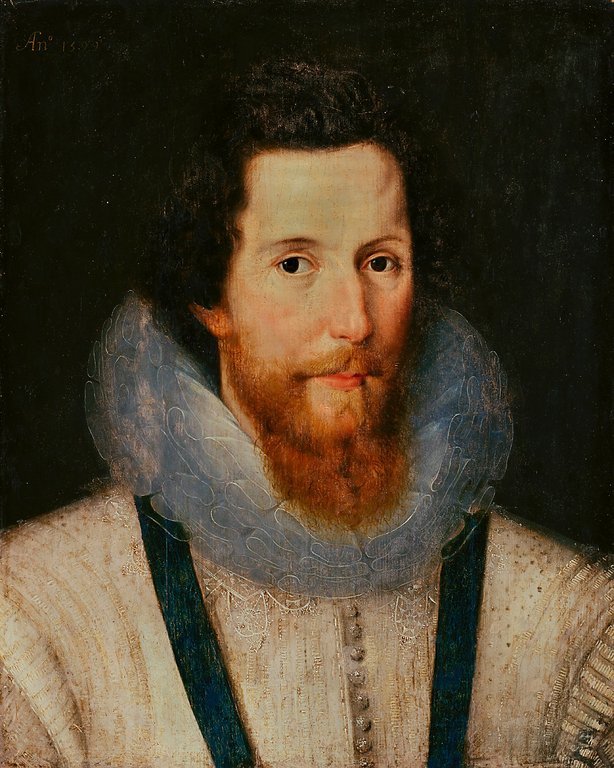
Robert Devereux, second Earl of Essex (1566-1601)

Essex was executed seventeen days after the aborted rising; but before the Queen’s death in 1603, Henry Percy, ninth Earl of Northumberland, wrote a letter to James telling him that Essex had thought it would be “scandalous to our nation that a stranger should be our king.”  [The fact that James had not been born on English soil made him legally ineligible to succeed Elizabeth, but Essex may well have had other reasons to say this as well.]

Essex “wore the crown of England in his heart these many years,” Percy told James, adding that therefore the earl had been “far from setting it on your head if it had been in his power.”

Chiljan offers more evidence on this subject, providing solid proof that Essex and Southampton were NOT acting on behalf of James; in fact, Essex had “inveighed against” James in his conversations with friends.  Essex had indeed corresponded with James – for example, two years before the Rebellion — but, Chiljan writes, that correspondence was only to request that the king send an ambassador to England.  “It appears,” she adds, “that Essex wanted James’ diplomatic support only after he had enacted a change of regime.” [My emphasis]

There is much additional evidence in Shakespeare Suppressed, which I highly recommend not only for these revelations but for its discussion of many other issues.  Katherine Chiljan has written a new Oxfordian/authorship book that wipes out the Stratford man forever.   I suggest it represents a new landmark book that belongs on our shelves.

In my book The Monument (2005) I suggested that the Earl of Southampton was not only the young man addressed in the Sonnets but also “the onlie begetter” of the dedication or “Mr. W.H.,” who had inspired the writing of them and  later caused them to be published.  Now Chiljan independently supports that argument with largely unknown documentation that Southampton had been associated professionally with publisher Thomas Thorpe five years before the 1609 printing of the Sonnets, and then again seven years afterward:

In 1604 Thorpe published A Succinct Philosophical Declaration of the Nature of Climacterical Years Occasioned by the Death of Elizabeth, written by Thomas Wright and dedicated to Southampton, who evidently sponsored the publication.   In 1616 Thorpe published The Praise of King Richard the Third by Sir William Cornwallis, using a manuscript that Southampton himself had altered, prior to co-leading the failed Essex Rebellion of February 8, 1601; and in this case, too, the evidence points to Southampton as the one who got the revised manuscript to Thorpe in 1616.  The earl’s alterations had cast a negative light on the historical Richard III, with whom Secretary Robert Cecil had been compared.

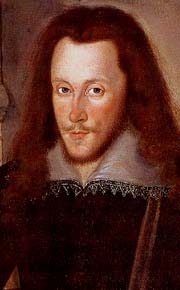
Henry Wriothesley, third Earl of Southampton (1573/4-1624)

“Southampton’s open patronage of one work published by Thorpe, and his being the evident supplier of the manuscript of another work published by Thorpe, strengthens his case as the source, the begetter, of SHAKE-SPEARE’S SONNETS,” concludes Chiljan.

“And she provides additional evidence that Southampton’s action to get the Sonnets published “may have been specifically directed to King James and his son [Prince Henry, 14) to remind them of his royal blood” — that is, as the natural son of Queen Elizabeth I by Edward de Vere, seventeenth Earl of Oxford, as depicted in the new movie Anonymous from Roland Emmerich.


Report on a Panel to Discuss “Anonymous” the Movie

Here’s my report on the panel discussion following a preview of ANONYMOUS last Saturday at the Chelsea 9 Theater in New York, sponsored by the Media Educators Association.

John T. Yurko, director of the group and chairman of the Communication Arts Department at Caldwell College, NJ, did a great job leading a question-answer session; and I was grateful to be on the panel with English professor Dr. Mary Lindroth and History & Political Science professor Dr. Ben Lammers, both from Caldwell, who made important contributions.   This account covers only some of the topics and it’s by no means intended to be complete.

First of all the audience seemed to really like the movie.  You could hear the proverbial pin drop as all attention was focused on the screen; and that alone is a great achievement on the part of screenwriter John Orloff and director Roland Emmerich, along with the cast and crew.

HISTORY OR FICTION:  How much true history is in the film?  I answered that the major characters and their relationships, along with major plot points, are most certainly real.  As an example I pointed out that in the movie there’s a performance of Richard III just before the abortive Essex Rebellion of 8 February 1601, when in fact the conspirators had gotten the Lord Chamberlain’s Men to play Richard II at the Globe.

Sir Robert Cecil, Principal Secretary

But the purpose in real history was the same – to signal an attempt to remove Secretary Robert Cecil from his control over the aging Queen Elizabeth I and persuade her to name an heir to the throne or, at the least, call a Parliament on the matter of succession.  The movie’s choice of Richard III instead of Richard II was to use the more dastardly king, depicted by Shakespeare as a hunchback, to remind the Globe audience of the hunchbacked Cecil; otherwise, the basic point is that a play by “Shakespeare” was definitely used for a political purpose — something that traditional teachings of Shakespearean history have tended to underplay or even to forget.

OTHER CANDIDATES: There was a question about authorship candidates other than Edward de Vere 17th Earl of Oxford, as depicted in the film.  I answered that in my view, if you look at Oxford’s biography it becomes very difficult to walk away.  Why do our teachers and students know so little about this pivotal figure within the English renaissance of literature and drama during the 1580’s?  Why do they usually neglect the crucial history leading to the sudden appearance of “Shakespeare” in 1593?  How come they seldom try to explain the great author’s full-blown maturity as exhibited by that highly cultured, sophisticated narrative poem, Venus and Adonis?  Was it a miracle?

SHAKESPEARE (OR SHAKSPERE) THE ACTOR:  Does the movie go too far in terms of making the Stratford man pretty much a buffoon?  Maybe so, I said, pointing out that in the “Oxfordian” community we’re still grappling with the question of what role that William Shakspere actually played, if in fact Edward de Vere was the true author.  My own feeling is that the Stratford man was never running around London claiming to be “Shakespeare” the poet-playwright.  In other words, I do not believe he was ever an active “front man” for the Earl of Oxford.

SHAKESPEARE’S PHYSICAL APPEARANCE:  In response to another question, I replied that the engraving in the First Folio, by Martin Droeshout, is the most “accurate” portrait the Stratfordians have – but, of course, the engraving is pretty much a cartoon.  You can see it’s a mask.

The Droeshout Engraving - 1623

THE TEMPEST:  One person asked how Oxford could have written The Tempest, since he died in 1604 and the play was written in 1611.  I asked:  “How do you know it was written then?”  He replied:  “Well, everybody says so.”  I think it was written much earlier than 1604; I also think, as some others do, that it was performed in 1604 for King James under the title The Spanish Maze.  (See some of the great work on the dating of The Tempest that’s being done by Dr. Roger Stritmatter and Lynne Kositsky.)

COLLABORATORS:  Someone wanted to know how all those “collaborations” could have taken place after 1604 if Oxford was dead by then.  I replied that other writers may have worked on some of the plays precisely because the author was no longer alive.  Of the thirty-six plays to appear in the First Folio of 1623, seven years after Will of Stratford’s death, exactly eighteen or half of them had never been printed before.  Why not?  And why would the living Shakespeare have needed any collaborators in the first place?

There were more questions and answers, of course; overall I felt a genuinely positive atmosphere and interest in learning more.  I tried to emphasize that one thing at stake is our understanding of the “creative process” itself and how we teach young people about it.

Are we teaching them that, because Shakespeare was such a great “genius” (which I’m sure he was), he had no need to draw upon any life experience and apprenticeship?  I suggested that, as the author Charles Beauclerk has said, imagination is being confused with fantasy; that is, the imagination used by Shakespeare must have required much more than fantasizing; on the contrary, it must have required a transmutation of many elements of learning and living and hard work.  And that’s what we need to tell those who represent our potential poets, novelists, playwrights and writers of the future.

I sense a new energy on its way, a new enthusiasm for Shakespeare, for literature, for theater, for film, for art  itself – all to replace the dull stuff that has “turned off” so many in previous generations.  A great dam is about to burst open; a great flood of new exploration and discovery is about to begin.

“Anonymous” Triggering the Great Shakespeare War! Shots Fired from the Professor! The Director is Firing Back!

Well, now, the Great Bard War is shaping up fast!  On one side is director Roland Emmerich, whose upcoming movie ANONYMOUS (Oct 28) is triggering attacks from behind the barricades of tradition, with Professor James Shapiro on the attack in this morning’s New York Times on the Op Ed page.

Hank Whittemore and Roland Emmerich

These are photos of yours truly with each of these fellows, on the eve of what I now predict will be a huge “game changer” when it comes to our perceptions of Shakespeare and the Elizabethan age … as students all over the world rush to corner their teachers and professors, demanding to know what they haven’t been told about Edward de Vere 17th Earl of Oxford and the relationship of his life and the works of Shakespeare — and, folks, there’s a real and specific relationship, a factual one, right on the record … which has been kept from students and even from teachers and scholars!

Look forward to this blog answering Shapiro point by point…

l

Hank Whittemore and James Shapiro


Here’s a “Smoking Gun” that brings together Edward de Vere (Oxford) and Henry Wriothesley (Southampton) in the Context of the 1601-1603 Aftermath of the Essex Rebellion

I’d like to present a document that brings together Edward de Vere Earl of Oxford and Henry Wriothesley  Earl of Southampton within the context of the Essex Rebellion of February 1601 and its aftermath until the death of Elizabeth and the succession of James in March 1603.  I consider it a “smoking gun” in terms of evidence of a relationship between them in connection with those events and that time period – supporting the context put forth and expanded within THE MONUMENT, my edition of the Sonnets (and its companion synopsis-volume SHAKESPEARE’S SON and HIS SONNETS, not to mention ANONYMOUS, the forthcoming movie from Roland Emmerich, due for general release October 28th.

The document is Anagrammata in Nomina Illustrissimorum Heroum (1603) By Francis Davison – published online by the Philological Museum by Dana F. Sutton.

The Anagrammata was a single-page broadsheet with anagrams & epigrams on the names of the following lords: Thomas Egerton, Charles Howard, Thomas Sackville, Chrarles Blunt, John Fortescue, Gilbert Talbot, Henry Percy, Edward de Vere and Henry Wriothesley.

The work was compiled partially during the time of Southampton’s imprisonment in the Tower [1601-1603] and completed after the queen’s death on March 24, 1603.  It was published later the same year. The anagrams/epigrams for Oxford and Southampton are presented ninth and tenth, respectively, as the final two lords.

“In general,” Professor Sutton writes, “the epigrams are fairly predictable exercises in courtly flattery.  A couple, however, may merit more consideration.  The one addressed to Oxford congratulates him on his non-involvement in the Essex Rebellion.  One wonders why Davison thought this necessary.  Even more curious is the one for Southampton, which explicitly states that he had been convicted of treason on false testimony inspired by envy.”

EDWARD VERE by an anagram AURE SURDUS VIDEO (“DEAF IN MY EAR, I SEE”)

“Though by your zeal, Fortune, you keep perfidy’s murmurs and schemings at a distance, nonetheless I learn (at which my mind and ear quake) that our bodies have been deafened with respect to evil affairs. Indeed, I perceive men who come close to Catiline in deception, freeing other men’s fates by their death.”

HENRY WRIOTHESLEY  by an anagram THESEUS NIL REUS HIC RUO (“HERE I FALL, THESEUS, GUILTY OF NOTHING”)

“Justly you were able to pour forth this complaint from your mouth; your lot was harsh while a false accusation prevailed. “Lo, Theseus is guilty of nothing; here I fall by an unfair lot’s censure, betrayed by envy’s whim.” But now the complaint is to be altered, because of altered perils. Great man, do you take a fall with an innocent heart bearing witness?  Not at all.  The heir, wielding the scepter of rule conferred under Jove’s auspices, grants you to live free of this care.”

I submit that THE MONUMENT and its synopsis-book SHAKESPEARE’S SON AND HIS SONNETS contain the explanation that Professor Sutton is seeking.  No, it’s not “proof” of the Monument Theory of the Sonnets, but there’s no question that it brings Oxford and Southampton together in connection with the post-Essex Rebellion history.

THE MONUMENT attempts to demonstrate that the Sonnets tell the following story:  Upon the failure of the Essex Rebellion of February 8, 1601, followed by the sentencing of Henry Wriothesley, Earl of Southampton to death for high treason, Edward de Vere, Earl of Oxford made a bargain with Secretary Robert Cecil in order to save Southampton’s life.  Essex was executed six days after the trial.  Oxford’s aim was to spare Southampton from execution and gain the promise of his release upon the succession of King James of Scotland as King of England.  Once liberated, Southampton would regain all his lands and titles and receive a royal pardon, freeing him from the threat of being re-arrested for the same crime.  But the outcome of the deal depended on Cecil’s ability to bring James to the throne, so Oxford had no choice but to help him.  In effect, he was blackmailed.

One way Oxford may have helped is by becoming “40” in the secret correspondence between Cecil and James, behind Elizabeth’s back.  Also, shortly before the Queen’s death, he apparently acted to test Lord Lincoln’s loyalty to James.  In addition, having adopted the pen name “Shakespeare” in 1593, Oxford now agreed to take another step – to bury his identity in relation to Southampton after his death and for generations to come:  “I may nevermore acknowledge thee … My name be buried where my body is,” he testifies in Sonnets 36 and 72.

The Southampton Prince Tudor Theory is that, in addition, Oxford and Southampton agreed to bury their father-son relationship; and that Southampton agreed to forfeit any claim to the crown as the natural heir of Queen Elizabeth.   [Two Oxfordians who oppose the Southampton Prince Tudor Theory, Nina Green and Christopher Paul, are thanked by Dana Sutton for suggesting that the Philological Museum include Davison’s Anagrammata.]

OBSERVATIONS:

Davison was the son of William Davison, whom Elizabeth had blamed for transmitting the warrant for execution of Mary Queen of Scots.  W. Davison and his family were ruined.  Upon the death of Secretary Francis Walsingham in 1590, Essex urged Elizabeth to name W. Davison to replace him.  The post was left vacant until 1596, when the queen gave it to Robert Cecil.

In a work in which every element has a potential or actual meaning beyond what is on the surface, Davison deliberately placed Edward de Vere and Henry Wriothesley one after the other.   As stated above, such placement lends support to the theory of THE MONUMENT that, as expressed in the Sonnets, Oxford and Southampton were linked together at this crucial time.

OXFORD EPIGRAM:

Catiline: Lucius Sergius Catilina (108 BC – 62 BC), known in English as Catiline, was a Roman politician of the 1st century BC who is best known for the Catiline conspiracy, an attempt to overthrow the Roman Republic, and in particular the power of the aristocratic Senate.  [The name of Catiline was invoked in relation to Essex and his supporters at the joint treason trial of him and Southampton on February 19, 1601.]

“Freeing Other Men’s Fates by Their Deaths” – the final words of the epigram to Oxford could refer to Essex as one who went to his death in order to give Southampton a chance to live; but this epigram is for Oxford and therefore, I submit, it more likely refers to the bargain Oxford made with Cecil to figuratively die, as in Sonnet 81: “I, once gone, to all the world must die.”

SOUTHAMPTON EPIGRAM:

Theseus:  the mythical founder-king of Athens, son of Aethra, and fathered by Aegeus and Poseidon, both of whom Aethra had slept with in one night. Theseus was a founder-hero, like Perseus, Cadmus, or Heracles, all of whom battled and overcame foes that were identified with an archaic religious and social order.

“False Accusation … Betrayed by Envy’s Whim” – perhaps refers to Cecil betraying Southampton by falsely accusing him of trying to overthrow Elizabeth and kill her.

“The Heir, Wielding the Scepter of Rule” – appears to refer to King James, who ordered the release of Southampton; but, given the Prince Tudor Theory that Henry Wriothesley was the natural heir of Elizabeth and deserved to become King Henry IX, such language is certainly tantalizing and even, one might say, provocative.

Reason No. 9 Why “Shakespeare” was Edward de Vere seventeenth Earl of Oxford: “I AM THAT I AM”:

“And God said unto Moses, I AM THAT I AM’: and he said, Thus shalt thou say unto the children of Israel, I AM hath sent me unto you.” — Exodus, 3.14

To my knowledge only two individuals during the Elizabethan age declared in writing, “I AM THAT I AM,” and apparently they did so within identical contexts: the author of Shakespeare’s sonnets and Edward de Vere, the seventeenth Earl of Oxford.

William Cecil Lord Burghley & His Mule

After composing a letter to his father-in-law William Cecil Lord Burghley on 30 October 1584, Edward de Vere signed off in his own hand.  Then he added a postscript bitterly protesting the chief minister’s attempts to use his own servants to spy on him.   He set forth the facts and continued (with my emphases):

“But I pray, my Lord, leave that course, for I mean not to be your ward nor your child.  I serve her Majesty, and I AM THAT I AM, and by alliance near to your Lordship, but free, and scorn to be offered that injury to think I am so weak of government as to be ruled by servants, or not able to govern myself.  If your Lordship take and follow this course, you deceive yourself, and make me take another course than yet I have not thought of.  Wherefore these shall be to desire your Lordship, if that I may make account of your friendship, that you will leave that course as hurtful to us both.”

(When Oxford warns, “If your Lordship take and follow this course, you … make me take another course than yet I have not thought of,” it appears that he anticipates King Lear’s outburst against his two selfish daughters, “I will do such things – what they are yet I know not; but they shall be the terrors of the earth.” – 2.4.280)

The other personal use of I AM THAT I AM occurs in Sonnet 121, which follows here with my emphases on SPIES as well as I AM THAT I AM; and can’t you feel the same mind at work?  The same protest … the same angry, accusing voice?

Sonnet 121

Tis better to be vile than vile esteemed,

When not to be receives reproach of being,

And the just pleasure lost, which is so deemed,

Not by our feeling, but by others’ seeing.

For why should others’ false adulterate eyes

Give salutation to my sportive blood?

Or on my frailties why are frailer SPIES,

Which in their wills count bad what I think good?

No, I AM THAT I AM, and they that level

At my abuses reckon up their own.

I may be straight though they themselves be bevel;

By their rank thoughts my deeds must not be shown;

Unless this general evil they maintain:

All men are bad and in their badness reign

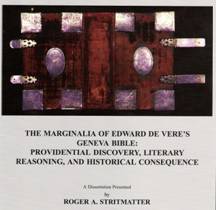
Dissertation on Oxford’s Geneva Bible by Dr. Roger Stritmatter

God’s words to Moses “I AM THAT I AM” are in the Geneva Bible, a gilt-edged copy of which Edward de Vere had purchased in 1569/70 from William Seres, stationer; and thanks to the landmark studies by Dr. Roger Stritmatter of that same copy, held by the Folger Library in Washington, D.C., we can be sure that the earl was intimately acquainted with its passages.  To put it bluntly, both Oxford and “Shakespeare” were biblical experts – one more reason why, in our view, they were one and the same.

Referring to the likelihood that Oxford’s postscript and Sonnet 121 were written virtually at the same time in response to the same situation, Percy Allen wrote in 1930: “So forcible, individual, and wholly characteristic an expression … is a very strong piece of corroborative evidence.” *

Sonnet 121 is positioned within Sonnets 107 to 126 — a sequence which, as expressed in The Monument, uses one sonnet per day from Sonnet 107 (Southampton’s release from the Tower on 10 April 1603) to Sonnet 125 (Queen Elizabeth’s funeral on 28 April 1603) and Sonnet 126 (the “envoy” of farewell).  This sequence is a thundering “movement” concluding the fair youth series to/about Southampton, but in no way does it preclude Oxford having originally written Sonnet 121 at the time he wrote the 1584 postscript; the likelihood is that he pulled out this old verse to use in the final construction of his “monument” for Southampton.

Here is my take on Sonnet 121 as it appears in The Monument:

THE FINAL DAYS

FOUR DAYS TO THE QUEEN’S FUNERAL
Sonnet 121
24 April 1603

Oxford records his commitment to the truth rather than to false appearances.  He repeats the words of God to Moses in the Bible – I AM THAT I AM – in echo of a postscript to Lord
Burghley in 1584, when Southampton was ten years old:  “I serve her Majesty, and
I am that I am.”  In reality, as father to a rightful king, he should be Elizabeth’s consort on the throne and, therefore, a king or god on earth entitled to use God’s words of self-description. Oxford here recalls his own postscript, related to “spies” working for Burghley and poking into his personal affairs.  Nearing the end of his diary, he also sums up his own life to be preserved in this monument.

1 ‘TIS BETTER TO BE VILE THAN VILE ESTEEMED,

“It’s better to be vicious that to be thought vicious” – Tucker; VILE = wicked; criminal; in this case, treasonous; “That I was of a strange and vile nature” – Oxford, in a memo circa 1601-1602, Cecil Papers 146.19; Chiljan, 72; quoting false charges against him; ‘TIS BETTER, etc. = Oxford would rather have the genuine guilt for his son’s crime than merely to be deemed guilty without making any sacrifice for him; “This vile traitor, Somerset” – 1 Henry IV, 4.3.33; TO BE = echoing Hamlet’s “To be or not to be” soliloquy, with “not to be” in line 2 below; indicating that he is undoubtedly revising Hamlet (Q2 of 1604) by now; ESTEEMED = deemed in the eyes of others, recalling the theme of Sonnet 29, line 14:  “Then I scorn to change my state with kings”

2 WHEN NOT TO BE RECEIVES REPROACH OF BEING,

WHEN NOT TO BE, etc. = when not actually wicked but blamed for being such; NOT TO BE = the other half of “To be or not to be,” the soliloquy of Hamlet, its full version to be published in the next year, 1604.

3 AND THE JUST PLEASURE LOST, WHICH IS SO DEEMED,

JUST = legal; the word “just” is on Oxford’s mind in this final Fair Youth sequence: “Just to the time, not with the time exchanged” – Sonnet 109, line 7; “And on the just proof surmise accumulate” – Sonnet 117, line 10; and it was on his mind near the end of the Dark Lady series, when Elizabeth was in her final eclipse: “Who taught me how to make me love thee more,/ The more I hear and see just cause of hate?” – Sonnet 150, lines 9-10; JUST PLEASURE = the happiness Oxford derives from having made a legal bargain for his son; also, for Southampton’s  “royal pleasure”; DEEMED = judged; “The Rose looks fair, but fairer we it deem/ For that sweet odor which doth in it live” – Sonnet 54, lines 3-4

4 NOT BY FEELING BUT BY OTHERS’ SEEING.

NOT, etc. = “Not in our opinion, but in the view of others” – Booth; Oxford and Southampton
do not agree with the loss of the throne, but that was arranged by others, i.e., Cecil and James; and the truth is that Southampton should have succeeded; OTHERS’ SEEING = the “others” see only the dark guilt of Southampton, and are unaware of or refuse to see (or take into account) his royal blood; in effect, they are blind and see only “darkness which the blind do see” – Sonnet 27, line 8

5 FOR WHY SHOULD OTHERS’ FALSE ADULTERATE EYES

FALSE = opposite of True, related to Oxford; also “false” related to treason as in “false traitor”; ADULTERATE = counterfeit; not truthful or real; FALSE ADULTERATE EYES = the false view of others that Southampton is a traitor; “I am thy King, and thou a false-heart traitor” – 2 Henry VI, 5.1.143; also, the false view that he is not a king by blood; “Why should false painting
imitate his cheek” – Sonnet 67, line 5; “Simply I credit her false-speaking tongue” – Sonnet 138, line 7, referring to Elizabeth; 6 GIVE SALUTATION TO MY SPORTIVE BLOOD?

SALUTATION = (“And in his private plot be we the first to salute our rightful sovereign with honor of his birthright to the crown” – 2 Henry VI, 2.2.5961; “Loud shouts and salutations from their mouths, even in the presence of the crowned king” – 1 Henry IV, 3.2.53-54); Oxford giving salutation to Southampton as a king; MY SPORTIVE BLOOD = i.e., Oxford’s reckless blood that is also part of Southampton’s reckless blood; echoing the royal blood of his son; “And that fresh
blood
which youngly thou bestow’st” – Sonnet 11, line 3

7 OR ON MY FRAILTIES WHY ARE FRAILER SPIES,

OR ON MY FRAILTIES, etc. = why do weaker people look on my weaknesses; “Frailty, thy  name is woman!” – Hamlet, 1.2.152, another indication that Oxford is revising that play at this time (see lines 1-2 and 8); FRAILER = lack of royal blood, i.e., less royal than my son, i.e., Robert Cecil, but even King James is less royal by blood than Southampton; SPIES = William and Robert Cecil both relied heavily on spies to assist them in running the government; recalling the spies Rosencrantz and Guildenstern, hired by Polonius-Burghley.
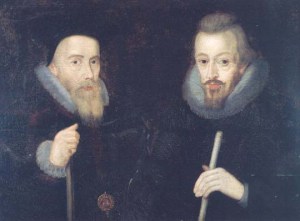
William Cecil Lord Burghley with his son and successor Robert Cecil, who both used networks of spies and informants

8 WHICH IN THEIR WILLS COUNT BAD WHAT I THINK GOOD?

WILLS = royal wills; the royal will of James; a play on “Will” Shakespeare; COUNT BAD WHAT I THINK GOOD = add up his royalty as nothing good or genuine = “To leave for nothing all thy sum of good” – Sonnet 109, line 12; “For there is nothing either good or bad but thinking
makes it so” – Hamlet, 2.2.250-251; COUNT = as in praying upon the Rosary beads: “Nothing, sweet boy, but yet like prayers divine,/ I must each day say o’er the very same,/ Counting no
old thing old, thou mine, I thine” – Sonnet 108, lines 5-7; referring to the accounting of Southampton’s royal blood; “What acceptable Audit can’st thou leave?” – Sonnet 4, line 12; “Her Audit (though delayed) answered must be,/ And her Quietus is to render thee” – Sonnet 126

9 NO, I AM THAT I AM, AND THEY THAT LEVEL

I AM THAT I AM = “And God said unto Moses, I AM THAT I AM” – Exodus, 3.14; I am myself alone – Richard in 3 Henry VI, 5.6.83; “you alone are you” and “you are you
– Oxford to Southampton, speaking to his royal son as king or god on earth, in Sonnet 84

"I serve her Majesty..."

“I serve Her Majesty, and I am that I am, and by alliance near to your Lordship, but free, and scorn to be offered that injury to think I am so weak of government as to be ruled by servants, or not able to govern myself.  If your Lordship take and follow this course, you deceive yourself, and make me take another course than yet I have not thought of.”

– Oxford writing to his father-in-law William Cecil Lord Burghley, the most powerful man in England, on October 30, 1584 – in a postscript in his own hand, when Southampton was ten years old and a ward of the Queen in Burghley’s custody.  Oxford was complaining about Burghley planting servants to spy on him (see “spies” in line 7 above); and in passing he angrily (and indirectly) reminded him that he, Oxford, was the father of a royal son and virtually a king entitled to be Elizabeth’s king-consort.

“Were I the Moor, I would not be Iago. In following him I follow but myself: Heaven is my judge, not I for love and duty but seeming so, for my peculiar end, for when my outward action doth demonstrate the native act and figure of my heart in complement extern, ‘tis not long after but I will wear my heart upon my sleeve for daws to peck at: I am not what I am” – Othello, 1.1.56-64

I am not as I seem to be,

For when I smile I am not glad:

A thrall although you count me free,

I, most in mirth, most pensive sad.

I smile to shade my bitter spite…

– Oxford poem, signed E. O. The Paradise of Dainty Devices, 1576

O that you were yourself, but love you are

No longer yours than you yourself here live

Sonnet 13, lines 1-2

(In the above lines, Oxford is reminding Southampton that he is no longer what he appears to be; i.e., he is a royal prince who cannot be himself in public)

This is I, Hamlet the Dane!

Hamlet, 5.2.255, the prince asserting his identity and independence

LEVEL = aim; “the direction in which a missive weapon is aimed” – Dowden; “The harlot king
is quite beyond mine arm, out of the blank and level of my brain” – The Winter’s Tale, 2.3.6

10 AT MY ABUSES RECKON UP THEIR OWN:

AT MY ABUSES, etc. = at my deceptions; “Is it some abuse?”– Hamlet, 4.7.49; RECKON UP THEIR OWN = add up their own lies; recalling “reckoning time” of Sonnet 115, line 5

11 I MAY BE STRAIGHT THOUGH THEY THEMSELVES BE
BEVEL.

BEVEL = heraldic for crooked; alluding to Oxford’s brother-in-law, the hunchbacked Robert Cecil, and his crooked physical figure

12 BY THEIR RANK THOUGHTS MY DEEDS MUST NOT BE
SHOWN,

RANK = despicable, foul, festering, large, grievous, bloated, serious, growing ever worse; “O, my offense is rank” – Hamlet, 3.3.36, King Claudius to himself; “Things rank and gross in nature possess it merely” – Hamlet, 1.2.136, the Prince, speaking of the world and specifically the state of
Denmark; the terrible, sinful thoughts of others who have deprived Southampton of his claim; but Oxford must stay silent; suggesting high rank or office; ranked in battle order

13 UNLESS THIS GENERAL EVIL THEY MAINTAIN:

UNLESS, etc. = unless they admit their evil openly and generally; unless they want to make the
following general argument:

14 ALL MEN ARE BAD AND IN THEIR BADNESS REIGN.

ALL = Southampton, One for All, All for OneALL MEN ARE BAD = Southampton is as “bad” or guilty as all men; but this is ironic, sarcastic; earlier, in the Dark Lady series, Oxford wrote to the still-living Elizabeth in desperate anger: “Now this ill-wresting world is grown so bad,/ Mad slanderers by mad ears believed be” – Sonnet 140, lines 11-12
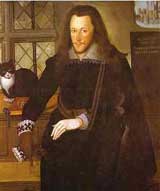
Southampton commissioned this portrait of himself in the Tower after his release by King James in April 1603.

“Why, then, ‘tis none to you; for there is nothing good or bad but thinking makes it so” – Hamlet, 2.2.250

AND IN THEIR BADNESS REIGN = and he “reigns” as King; (i.e., Oxford standing the whole
picture on its head, reverting back to line 1; so it’s better to be a real king, i.e., one with true rights, than just to be esteemed as one; and if his son is regarded as un-royal, then he should “reign” as king anyway); the new ruler is King James, along with Robert Cecil; and they are reigning over England in all their evil or badness; REIGN = the final word of the sonnet, emphasizing the true nature of the verse as political and related to the issue of whose reign  it should be.

“Save her alone, who yet on th’earth doth reign …” – Oxford poem, The Paradise of Dainty Devices, 1576, referring to Queen Elizabeth

* The Case for Edward de Vere, 17th Earl of Oxford as “Shakespeare” by Percy Allen, 1930

“Anonymous” the Movie to Focus on the End Game of Elizabethan Politics, the Essex Rebellion and the Succession to Queen Elizabeth

Well, it’s good to see the trailer for Anonymous, due in September from Roland Emmerich, about Edward de Vere, 17th Earl of Oxford as Shakespeare; and in the view from this corner, it’s great to see that the film will apparently focus on the “end game” of political power struggles leading to the Essex Rebellion in February of 1601, the imprisonment of co-leaders Essex and Southampton, the execution of Essex and the succession to Elizabeth in March of 1603.

These, after all, were not only the Earl of Oxford’s concerns but those dramatized by “Shakespeare” in his plays of English royal history, which mirrored contemporary issues and helped to prepare citizens for the inevitable changes that would follow the Queen’s death.  Such is the concern of the Sonnets, as expressed in The Monument, which sets forth the political “story” recorded by Oxford using the language and form of the poetry of love.

Because of a single movie, this generation of students will be the first to learn there’s even a question about the authorship of the Shakespeare works – a fact which, I’d say, boggles the mind.

A Sharply Critical Review of Stephen Greenblatt’s New Book by William Niederkorn

I’d like to recommend a review by William S. Niederkorn, formerly of the New York Times, in the current Brooklyn Rail – Critical Perspectives on Arts, Politics, and Culture.

William Niederkorn

He reviews Shakespeare’s Freedom (a series of lectures) the latest book from Harvard professor Stephen Greenblatt, whom he calls “The Bard’s Evangelist.”

Greenblatt’s biographical fantasy Will in the World (2004) was a bestseller despite the fact that it demonstrated (yet again) the lack of evidence that William of Stratford could even write, much less create plays such as Hamlet, Julius Caesar, King Lear, Richard III, Richard II, The Merchant of Venice, etc., etc.

My only question is whether, deep down, Professor Greenblatt actually believes the things he conjectures about the man who was Shakespeare.

"Shakespeare's Freedom" by Stephen Greenblatt

For example, in the “biography” mentioned above he turns to the question of how in blazes the newly arrived actor from Warwickshire came to write seventeen private sonnets urging the seventeen-year-old Earl of Southampton to hurry up and marry and have a child to continue his bloodline … not to mention how the actor-poet could have had the courage (and sheer madness) to lecture and even scold the earl for refusing to obey — “Murderous shame! … Profitless usurer!” — and finally to beg him to beget a child in the most personal way:  “Make thee another self for love of me.”

The circumstance in the early 1590’s was that Queen Elizabeth’s chief minister William Cecil Lord Burghley was pressuring Southampton, a royal ward in his custody, to marry his own granddaughter, the fifteen-year-old Lady Elizabeth Vere, daughter [of record] of Edward de Vere Earl of Oxford … who, according to the ever-growing evidence, was the true “Shakespeare.”

Stephen Greenblatt

It is possible,” Greenblatt wrote, in effect warning us he was about to take a wild and totally unsupported guess, “that some one, either in the circle of Burghley or in the circle of Southampton’s mother, had taken note of the fact that the young earl was excited by the talents or by the person of an actor who was also a promising poet.”

How could the professor write such stuff?

“Whoever noticed this excitement – and a wealthy nobleman’s slightest inclinations would have been carefully watched – might well have had the clever idea of commissioning the poet to try his hand at persuading the narcissistic, effeminate young earl to marry.  Such a commission would help to account for the first seventeen of the extraordinary sequence of 154 sonnets…”

Sir George Greenwood

Let’s call upon Sir George Greenwood, whose 1908 book The Shakespeare Problem Restated still stands as a classic in the anti-Stratfordian world.  Oh, how I’d love to see a debate between Greenblatt and Greenwood on the authorship question; I have no doubt that the latter would win hands down.

“The idea that Will Shakspere, the young provincial actor,” Sir George wrote,  “was writing a succession of impassioned odes to the young Earl of Southampton, urging him to marry at once and become a father ‘for love of me’ appears to me, in the absence of anything like cogent evidence to that effect, simply preposterous.”

He was right.  And if he’d heard Greenblatt’s suggestion that Shakspere of Stratford might have been “commissioned” to write the sonnets urging Southampton to marry and procreate, he would have thought it even more preposterous!

“In Shakespeare’s Freedom,” Niederkorn writes, “Greenblatt is careful to avoid authorship issues and the sticky problems that he and a considerable majority of Shakespeare professors refuse to face as they ridicule the subject and preclude it from academic study.”

Among those problems, he notes, is the “vexing question” of how Shakespeare escaped punishment for his play Richard II, which the Queen herself knew had been used as propaganda for the Essex Rebellion of February 8, 1601, whose leaders (Essex and Southampton) were accused and found guilty of high treason.

Niederkorn’s final lines in the review amount to a direct hit against the “scholarship” of Professor Greenblatt, who, he reminds us, has equated doubts about the authorship to “claims that the Holocaust did not occur.”

I won’t steal Niederkorn’s thunder by repeating his final lines, but I will take this opportunity to commend him for having the courage to raise his voice amid the crowd and to speak the truth that’s finally coming to light — the truth that “Shakespeare” was not, after all, the man named William Shakspere of Stratford.