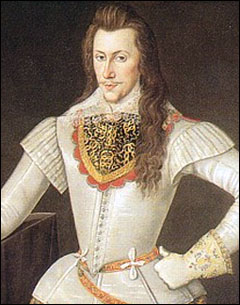
Re-posting Part Two of Reason 20 Why Shake-spreare was Oxford: The Depth of the Dedications to the Earl

The public dedications to Edward de Vere indicate the scope of his personal relationships with other writers.  The person who eventually created the “Shakespeare” works did not develop in a vacuum; on the contrary, he had to be part of a community of fellow authors, poets and playwrights. Oxford was not only part of such a community; the tributes make clear he was their leader.

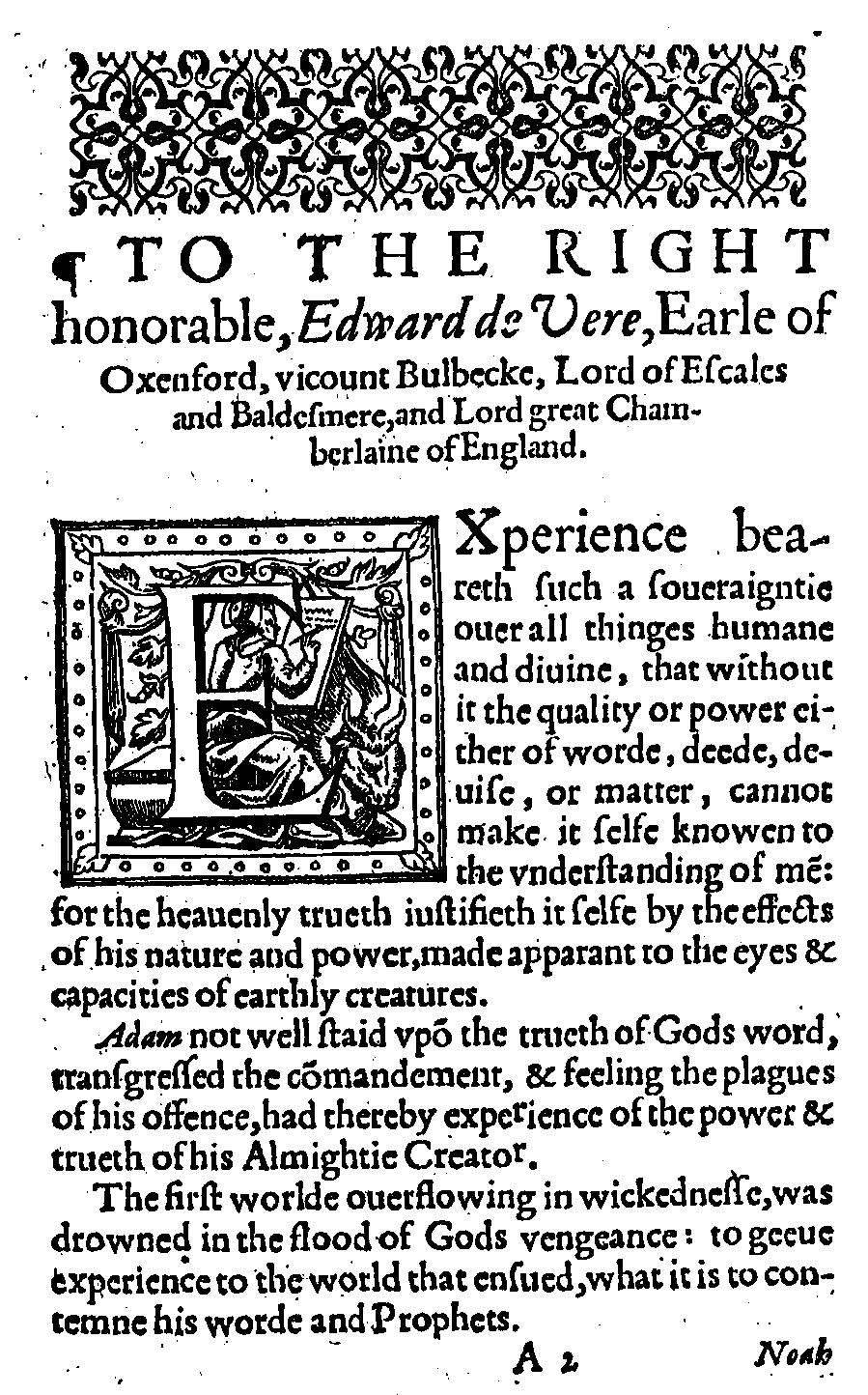
"The Histories of Trogus Pompeius" by Golding, dedicated to 14-year-old Edward de Vere in 1564

(Click on Image to Enlarge)

Arthur Golding (Histories of Trogus Pompeius) wrote to him in 1564: “It is not unknown to others, and I have had experiences thereof myself, how earnest a desire your Honor hath naturally grafted in you to read, peruse, and communicate with others as well the histories of ancient times, and things done long ago, as also of the present estate of things in our days, and that not without a certain pregnancy of wit and ripeness of understanding.”

Thomas Underdowne (AEthiopian History) told him in 1569 that “matters of learning” were good for a nobleman, but then warned the earl that “to be too much addicted that way, I think it is not good.”

In that same year the 19-year-old Oxford ordered “a Geneva Bible gilt, a Chaucer, Plutarch’s works in French, with other books and papers” as well as “Tully’s and Plato’s works in folio, with other books.”  Sounds indeed like a young man “addicted” to learning!

When Thomas Bedingfield dedicated his translation of Cardanus’ Comforte to Oxford in 1573, he told him that “I do present the book your Lordship so long desired,” confirming that the Earl had been personally involved in this publication, to which he contributed both a Letter to the Reader and a poem.   He reminds Oxford of “the encouragement of your Lordship, who (as you well remember), unawares to me, found some part of this work and willed me in any wise to proceed therein.”

Elizabeth & Courtiers

The distinguished physician Thomas Twyne (Breviary of Britain) referred to him in 1573 as being “in your flower and tender age” before inviting him to bestow  upon his work “such regard as you are accustomed to do on books of Geography, Histories, and other good learning, wherein I am privy your honour taketh singular delight.”

When Anthony Munday (Mirror of Mutability), told Oxford in 1579 that he looked forward to “the day when as conquerors we may peacefully resume our delightful literary discussions,” he was apparently referring to the rivalry between the Euphuists under Oxford and the Romanticists, who included Philip Sidney and Gabriel Harvey.  His reference to “our delightful literary discussions” offers a glimpse of Oxford personally engaged with other writers who were developing a new English literature and drama leading to “Shakespeare.” The works created by members of this circle would become known as “contemporary sources” upon which the great author drew.

Thomas Watson (Hekatompathia, or The Passionate Century of Love) reminded Oxford in 1580 that he had “willingly vouchsafed the acceptance of this work, and at convenient leisures favorably perused it, being as yet but in written hand.”  He cited de Vere as a literary trendsetter whose approval would draw many readers; because of this influence, the earl’s acceptance of the work in manuscript meant that “many have oftentimes and earnestly called upon me to put it to the press.”

Angel Day (The English Secretary) wrote to him in 1586 to Oxford about “the learned view and insight of your Lordship, whose infancy from the beginning was ever sacred to the Muses.”

Robert Greene (Card of Fancy) wrote publicly to Oxford in 1584 that he was “a worthy  favorer and fosterer of learning [who] hath forced many through your excellent virtue to offer the first-fruits of their study at the shrine of your Lordship’s courtesy.”

Dedication of “Defense of the Military Profession” by Gates to Oxford, 1579 (Click on Image to Enlarge)

In 1591 the composer John Farmer, who apparently lived in Oxford’s household, dedicated his first songbook (Plain-Song) to the earl, saying he was “emboldened” because of “your Lordship’s great affection to this noble science” (music) – which, of course, must be said also of Shakespeare.  In his second dedication (First Set of English Madrigals, 1599), Farmer told Oxford that “using this science as a recreation, your Lordship have over-gone most of them that make it a profession.”

In other words, Oxford encouraged young writers with their very first works, guiding them to the press.

Unlike the majority of dedications to patrons, the comments to Oxford are genuine and heartfelt. The earl may have had many faults of character, such as a tendency to be jealous and vengeful (as a number of Shakespearean characters are), but among his fellow writers and other artists he was uniquely spirited and generous.

In his Oxford biography Monstrous Adversary (2003), the Stratfordian scholar Alan Nelson concedes that Edward de Vere “attracts the attention of theologians, poets, distillers, and a musician, who have translated works from the Continent, or composed original works in English.” Citing the Index of dedications prior to 1641 by Franklin B. Williams (1962), he notes that only Queen Elizabeth and a few more powerful nobles had more dedications: Leicester (114); Burghley (85); Walsingham (47); and Charles Howard, the Admiral and hero of England’s victory over the Spanish Armada (46).

“CARDANUS Comforte, translated And Published by commaundement of the right Honourable the Earle of Oxenforde.” (1576 edition; click on image to enlarge)

In her Master of Arts in English thesis of 1999 at the University of Texas, focusing on Oxford’s patronage, Jonni Koonce Dunn notes that nearly forty percent of it was “expended on fiction with an Italian flavor.” The result, she adds, is that the Earl “provided the late sixteenth century with a body of source works to which the literature of the English Renaissance is sorely indebted.” Even from a young age, he preferred “literary work over the devotional or practical,” and such works “lent themselves to being models for adaptation for the forerunners of the novel as well as being instrumental in the development of English drama.”

His introduction as a young man to works such as The Courtier and Cardanus’ Comforte, she adds, “suggests his desire to be instrumental in shaping what was read by the university student and the courtier, thus in a roundabout way to transform the Elizabethan court into the cultured society depicted at Urbino in Castiglione’s work … It would eventually come to pass that William Shakespeare would benefit from the works de Vere patronized, for his plays came to make use of practically every one of the literary number in some fashion.” Without such patronage, many of the sources used by Shakespeare “might not have been available to him for inspiration,” and therefore this critical contribution “should ensure Edward de Vere the gratitude of every student of literature.”

[This post is now No. 38 of 100 Reasons Shake-speare was the Earl of Oxford (2016)]

Re-Posting No. 20 (part one) of 100 Reasons why Oxford was “Shakespeare” – The Many Dedications to Him

As far as I can determine, at least twenty-eight publications can be verified as dedicated (wholly or in part) to Edward de Vere by name during his lifetime. To that list we might add three more items: in 1592 Thomas Nashe apparently dedicates Strange News to Oxford, using another name for him; in 1603 Francis Davison includes him in a curious political broadsheet or circular; and in 1619 Anthony Munday dedicates a book to Henry de Vere, 18th Earl of Oxford, with warm posthumous praise for Edward de Vere, 17th Earl of Oxford, his father, this bringing a tentative total to thirty-one.

Spenser’s dedicatory sonnet to Oxford referred to “the love which thou dost bear/ To th’Heliconian ymps [offspring from Helicon, the Greek abode of Apollo and the Muses), and they to thee,/ They unto thee, and thou to them most dear”

These dedications appear in works that range from Greek history to English literature, geography, military matters, music, medicine, astrology, translations from Italian and French, the Psalms, and so on — mirroring the wide range of subjects that Shakespeare was interested in from the European renaissance; they were very much part of the new age of English literature of which Edward de Vere was a central — perhaps the central — moving force prior to Shakespeare’s entrance in 1593.

The dedications to Oxford were not merely public bids for patronage; they were not the usual stuff of obsequious praise. On the contrary, they came from writers who worked with Oxford in developing common political and artistic goals.  Over and over they thanked him personally for taking time to read their works and give his advice.  He was not some lofty noble keeping his distance; instead, he rolled up his sleeves and became involved — personally, artistically and financially — in their varied works that covered so many subjects and forms of literary expression.

Here is a list of authors and their books with dedications to Oxford:

1/ 1564: Arthur Golding, Histories of Trogus Pompeius (Translation)

2/ 1569: Thomas Underdowne, An AEthiopian History Written in Greek by Helidorus (Translation)

3/ 1570: Edmund Elviden, Pesistratus and Catanea (Poetry)

4/ 1571: Arthur Golding, Psalms of David (Translation)

5/ 1573: Thomas Bedingfield, Cardanus’ Comforte (Translation)

6/ 1573: Thomas Twyne, Breviary of Britain … (Translation) [“Containing a Learned Discourse of the Variable State and Alteration thereof, under Divers as well as Natural, as Foreign Princes and Conquerors, together with the Geographical Description of the same…”]

“The New Jewell of Health” (1576) by Dr. George Baker, who dedicated two other books to Oxford

7/ 1574: George Baker:  Oleum Magistrale (medical; translation of Aparico de Zubia’s pamphlet) [“The Composition or Making of the Most Excellent and Precious Oil called Oleum Magistrale …” (Baker was surgeon to Oxford)]

8/ 1577: John Brooke, The Staff of Christian Faith, [translation of Guido’s French work into English) [“…profitable to all Christians … Gathered out of the Works of the Ancient Doctors of the Church…”]

9/1578: Gabriel Harvey, Gratulationum Valdenis (a book in Latin) [Celebrating the queen’s visit that year to Audley End; includes dedications in the first three parts to Elizabeth, Leicester and Burghley; and in part four to Oxford, Hatton and Sidney]

10/ 1578 (?): Anthony Munday, Galien of France (a book, now lost, that Oxford’s servant Munday, in The Mirror of Mutability, says he had dedicated to Oxford)

11/ 1579: Anthony Munday, The Mirror of Mutability (verses) [to serve as a religious companion to “The Mirror of Magistrates” – presenting a series of metrical tragedies “selected out of the sacred Scriptures,” illustrating the Seven Deadly Sins with biblical stories.]

12/ 1579: Geoffrey Gates, The Defense of Military Profession (a book in English) [An argument for the acceptance of the military man, and the military profession, as an essential and reputable member of society.]

13/ 1580: Anthony Munday, Zelauto, the Fountain of Fame (prose fiction) [This is the fifth or sixth Elizabethan novel, three of which are associated with Oxford: The Adventures of Master F.I., anonymous, part of A Hundredth Sundry Flowres, 1573; Euphues, The Anatomy of Wit (Lyly), 1578, and Euphues and his England (Lyly), 1580 (next on this list)].

Click on Image to Enlarge

14/ 1580: John Lyly, Euphues and His England (novel) [His first novel, Euphues: The Anatomy of Wit (1578) was dedicated to Sir William West; the connection between them is not known.]

15/ 1580: John Hester, A Short Discourse … Upon Chirurgerie (Surgery) (translation) [Italian medical work by Leonardo Phioravanti (Fioravanti) Bolognese, rendered in English]

16/ 1581: Thomas Stocker, Diverse Sermons of Calvin (translation)

17/ 1582: Thomas Watson, Hekatompathia, or The Passionate Century of Love (100 sonnets, in English)

18/ 1584: John Southern, Pandora (compilation of verses) [Contains four epitaphs attributed to Oxford’s wife, Anne Cecil, written upon the death of their infant son; also one by Queen Elizabeth.]

19/ 1584: Robert Greene, Gwydonius: The Card of Fancy (“wherein the Folly of those carpet Knights is deciphered”) [Romance novel in English]

Title Page of “The English Secretary,” first edition, 1586, with a dedication to Oxford referring to his “exceeding bounty” or generosity

20/ 1586: Angel DayThe English Secretary (“wherein is contained a Perfect Method for the inditing of all manner of Epistles and familiar letters”) [Instructions on how a particular type of letter should be written, followed by sample letters.]

21/ 1588: Anthony MundayPalmerin d’Olivia Pt. 1 – The Mirror of Nobility, (translation of a Spanish chivalric romance)

22/ 1588: Anthony MundayPalmerin d’Olivia Pt. 2 (translation) [More of his “romances of chivalry” from the Spanish]

23/ 1590: Edmund SpenserThe Faerie Queen (book-length narrative poem) [One of the seventeen dedicatory sonnets is to Oxford, with reference to him as a poet.]

24/ 1591: John FarmerPlainsong Diverse & Sundry (songbook) [Full title is “Divers and Sundry Waies of Two Parts in One to the Number of Fortie upon One Playn Song.” A collection of forty canonic pieces written by him, plus one poem.]

1592 (Not part of list): Thomas NasheStrange News (polemical pamphlet) [In response to Gabriel Harvey’s attack on Greene, dedicated to a prolific poet he calls by the pseudonym “Gentle Master William, Apis Lapis,” saying to him, “Verily, verily, all poor scholars acknowledge your as their patron” — with “verily, verily” as an apparent play on Oxford’s name “Vere” and describing his unique role as a patron of poets, writers and scholars needing his support.]

25/ 1597: Henry LokThe Book of Ecclesiastes (book of verse) [Published by Richard Field, who had published Venus and Adonis in 1593 as by “William Shakespeare”; in this work, Lok addresses a dedicatory sonnet to Oxford — perhaps originally written in manuscript in a gift copy of the book for the Earl.]

26/ 1599: John FarmerThe First Set of English Madrigals (songbook)

27/ 1599: Angel Day, The English Secretary (new edition, revised)

28/ 1599: George Baker,The Practice of the New and Old Physic (medical book) [Originally printed in 1576 under the title New Jewel of Health, then dedicated to Oxford’s wife, Anne Cecil, who died in 1588; now Baker is one of the Queen’s physicians; the dedication to the Countess of Oxford is slightly altered to suit the Earl.]

In addition, these explicit mentions of him:

1603: Francis Davison, Anagrammata (broadsheet) [With curious writings in Latin to/about Oxford and Southampton and other nobles, with political overtones, some apparently related to the Essex rebellion of 1601.]

1619: Anthony Munday: Primaleon of Greece (translation) [“Describing the knightly deeds of armes, as also the memorable adventures of Prince Edward of England. And continuiong the former historie of Palmendos, brother to the fortunate Primaleon” — dedicated to Henry de Vere, the 18th Earl of Oxford, who was Edward’s son by Elizabeth Trentham, with warm praise from Munday for the father.]

These authors, and their books dedicated to the Earl of Oxford, have been cited as specific “sources” upon which “Shakespeare” drew. Yet we know of no book or literary work of any kind that was dedicated to Shakespeare.

[This post is now Reason 37 in the book 100 Reasons Shake-speare was the Earl of Oxford.]

[Once again thanks to editor Alex McNeil; also to Brian Bechtold with editorial help; and to Jonni Koonce Dunn for her Master of Arts thesis of 1999 at the University of Texas.]

Re-Posting No. 19 of 100 Reasons Why Shake-speare was Edward de Vere, Earl of Oxford: The Polonius-Hamlet Family

An obvious link in the chain of evidence connecting Edward de Vere to “Shakespeare” is the similarity of his and Hamlet’s family relationships:

Queen Gertrude as played by Glenn Close

Gertrude is the mother of Hamlet, while Elizabeth was the legal mother of Oxford, when he was her ward.

Polonius as played by Eric Porter

Polonius is chief adviser to Gertrude, while Burghley (William Cecil) was chief adviser to Elizabeth.

Hamlet is engaged to young Ophelia, daughter of Polonius, while Oxford became engaged to young Anne Cecil, daughter of Burghley.

Ophelia as played by Helena Bonham Carter

Ophelia’s older brother, Laertes, goes off to Paris, his behavior causing great distress to his father, who recites the famous “precepts” to him as guidance. Anne’s eldest brother, Thomas Cecil, went off to Paris, his behavior causing great distress to his father, Burghley, who wrote him long letters full of wise “precepts” as guidance. Later he would also write his famous precepts to son Robert Cecil.

Claudius, who fatally poisons Hamlet’s father and marries the prince’s mother the queen, thereby becoming king, reflects Elizabeth’s lover Robert Dudley, Earl of Leicester, who was suspected of many poisonings. Oxford may have concluded that Leicester had caused the death by poisoning of his own father, John de Vere, 16th Earl of Oxford.

In Hamlet, the Shakespeare play carrying the most autobiographical tone of them all, we find the main character in virtually the same web of family relationships at court as Edward de Vere.  Traditional scholars may ask rhetorically, Well, now, you’re not claiming this as proof that Oxford wrote Hamlet, are you?” We might reply, “No, of course not, but doesn’t this give you a little queasy feeling in the gut?  Don’t you have the slightest tremor of doubt that Will of Stratford could have, or would have, written such a play?  Do you think this mirror image of family relationships can be mere coincidence?”

James Shapiro of Columbia University argues in Contested Will that “such claims about representing on the public stage some of the most powerful figures in the realm betray a shallow grasp of Elizabethan dramatic censorship.”  He adds that Edmund Tilney, Master of the Revels, “whose job it was to read and approve all dramatic scripts before they were publicly performed, would have lost his job – and most likely his nose and ears, if not his head, had he approved a play that so transparently ridiculed privy councilors past and present.”

Perhaps it is Shapiro himself who betrays a shallow grasp of what is really happening on the public stage. The author himself supplies a further clue to this when an exasperated Polonius, speaking of Hamlet, tells Gertrude: “He will come straight.  Look you lay home to him.  Tell him his pranks have been too broad to bear with, and that your Grace hath screened and stood between much heat and him.” Hamlet-Oxford has taken too many liberties, unbearably so, but nonetheless the queen has protected him from “much heat” and/or reprisals by government officials [such as Tilney] and his enemies at court.

Otherwise, Shapiro is right: not only Tilney but also the playwright surely would have lost his head … if he had been Shakspere of Stratford!

(This post, with great help from editor Alex McNeil, is now No. 9 of 100 Reasons Shake-speare was the Earl of Oxford)


Re-Posting No. 18 of 100 Reasons Why Shake-speare was Edward, Earl of Oxford: “Minerva Britanna” by Henry Peacham: “By the Mind I shall be Seen”

“Minerva Britanna” by Henry Peacham, Master of Arts (1612) – “Or a Garden of Heroical Devices, furnished, and adorned with Emblems and Impresa’s of sundry natures, Newly devised, moralized, and published.”

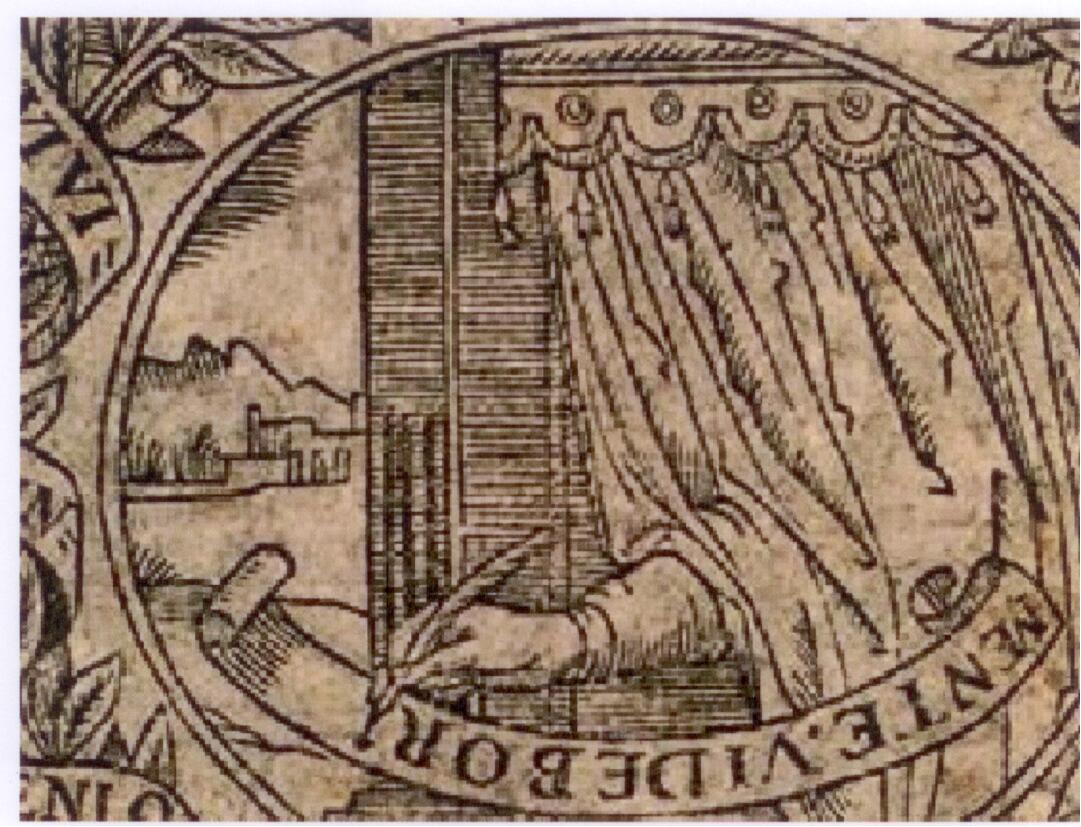
If there’s a single Elizabethan or Jacobean picture that cries out “Secret author,” it appears on the title page of Minerva Britanna by Henry Peacham, a book of original emblems (accompanied by his own verses) published in London in 1612. Shown on the front is the proscenium arch of a theater, with the curtain drawn back so we can see the right hand and arm of a writer using a quill pen to complete a Latin inscription:

MENTE.VIDEBORI (“By the Mind I shall be Seen”): The suggestion is that the author, who is behind the curtain, must remain hidden.

In 1937, Eva Turner Clark argued that the phrase MENTE.VIDEBORI is a Latin anagram of TIBI NOM. DE VERE or “The Identity of this Author is  De Vere.”

A closer look reveals that the “dot” in the inscription has been placed directly between the “E” and the “V” to create E.V., the initials of Edward Vere.

Oxford’s death date is recorded as 24 June 1604, the same year the authorized, full-length version of Hamlet was first published, after which no new “authorized” Shakespeare plays were printed for nineteen years.

In 1622, just one year before the publication of the First Folio, Peacham published a treatise entitled The Compleat Gentleman, in which he looks back at the Elizabethan reign as a “golden age” that produced poets “whose like are hardly to be hoped for in any succeeding age.”  He lists those “who honored Poesie [poetry] with their pens and practice” in this order:

“Edward Earle of Oxford, the Lord Buckhurst, Henry Lord Paget, the noble Sir Philip Sidney, M. Edward Dyer, M. Edmund Spenser, Master Samuel Daniel, with sundry others…” Curiously, he does not list “Shakespeare.”

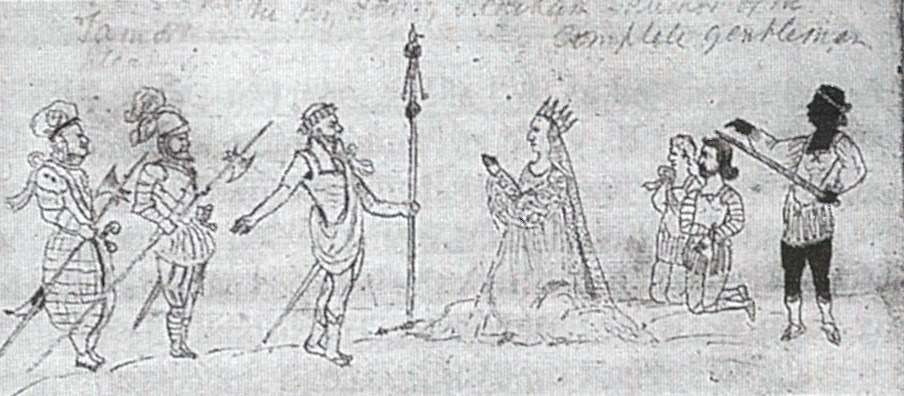
Peacham (1576?-1644?), a graduate of Cambridge, had been interested in the theatrical world early on; a surviving sketch of a scene of Titus Andronicus, thought to have been made in 1595, was signed “Henricus Peacham.” He would have been a teenager when he drew the sketch.  In the scene, Queen Tamora is pleading for the lives of her two sons while Aaron the Moor gestures with his sword.

A sketch of a scene of “Titus Andronicus” in 1595, apparently by Peacham when he was seventeen 

Oxford’s arms with the blue boar on top

At age twenty-five in 1603, Peacham became a schoolmaster at Kimbolton Grammar School; his Minerva (“Or a Garden of Heroical Devises, furnished and adorned with Emblems and Impresa of sundry natures”) contains 206 emblems, each accompanied by a pair of six-line stanzas. Roger Stritmatter reports that it “has long been considered the most sophisticated exemplar of the emblem book tradition ever published in England.”

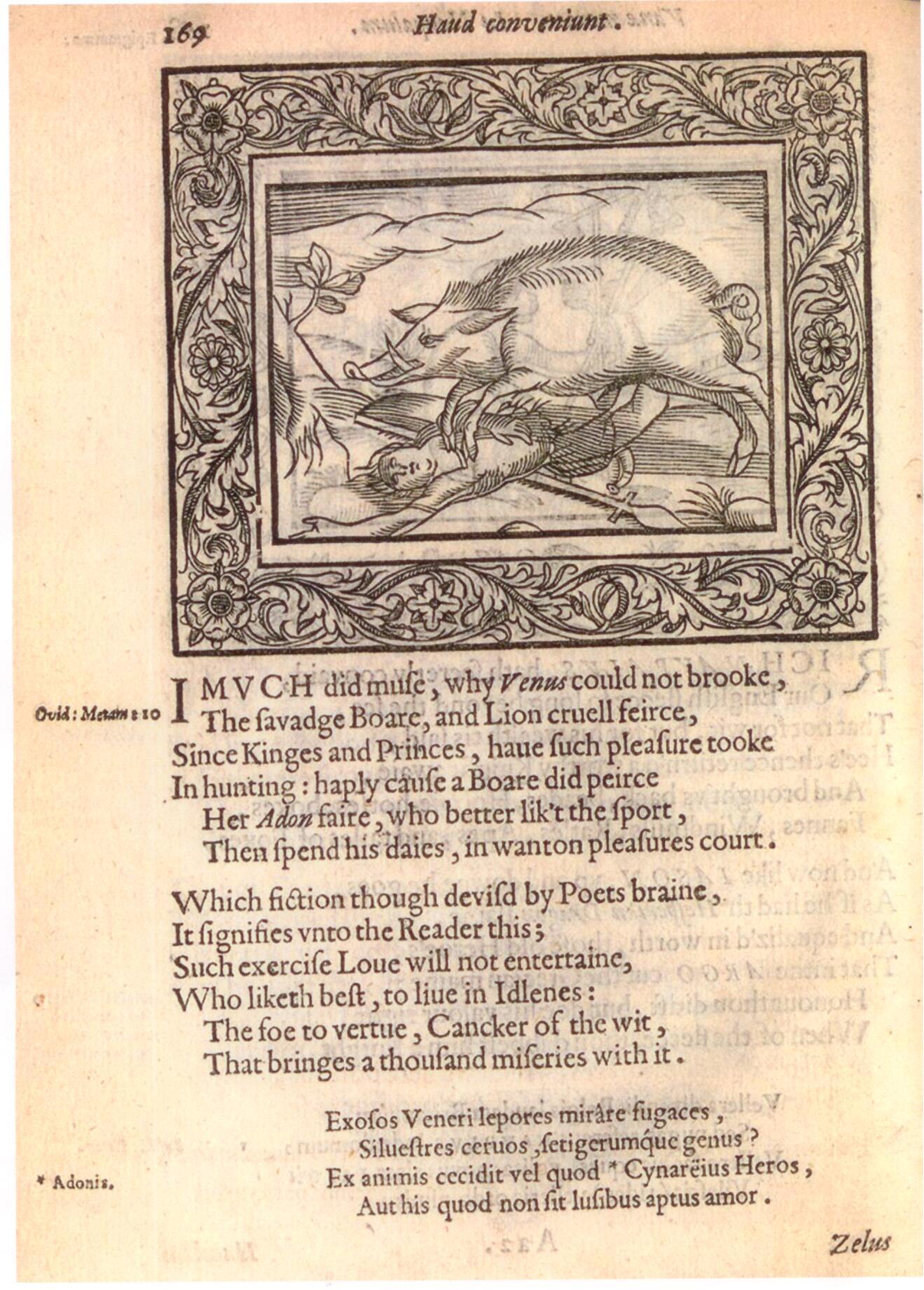
One of the emblems in Minerva shows a boar, which plays a crucial role in Ovid’s story of Venus and Adonis as well as in the one by “Shakespeare” published in 1593. The boar was also Oxford’s heraldic symbol. Below the emblem, Peacham writes:

One of the Emblems of “Minerva Britanna” — about “Venus and Adonis” featuring the Boar

I much did muse why Venus could not brook

The savage Boar and Lion cruel fierce,

Since Kings and Princes have such pleasure took

In hunting: ‘cause a Boar did pierce

Her Adon fair, who better liked the sport,

Then spends his days in wanton pleasure’s court.

Which fiction though devised by Poet’s brain,

It signifies unto the Reader this:

Such exercise Love will not entertain,

Who liketh best, to live in Idleness:

The foe to virtue, Canker of the Wit,

That brings a thousand miseries with it.

The line “Who liketh best to live in Idleness” is a direct reflection of what Oxford had written in 1576:

That never am less idle lo, than when I am alone *

Clearly Peacham was well aware, even in 1612, of an authorship mystery involving the poet of Venus and Adonis. With his emblem containing the boar symbol of the Vere earldom and those lines underneath it, he brought together “Shakespeare” and Oxford on the same page, providing the solution for all to see.

  • In The Paradise of Dainty Devices, 1576

(This blog post, with the invaluable help of editor Alex McNeil, has become No. 95 of 100 Reasons Shake-speare was the Earl of Oxford.)

Re-Posting No. 16 of “100 Reasons” why the Earl of Oxford = “Shakespeare”: Bertram in “All’s Well That Ends Well”

The leading male character in All’s Well That Ends Well is Bertram, Count of Rousillon, a young French nobleman whose callous self-absorption leads to bad behavior toward his wife. In many respects, Bertram is a representation of a young English nobleman, Edward, Earl of Oxford, whose callous self-absorption led to bad behavior toward his wife.

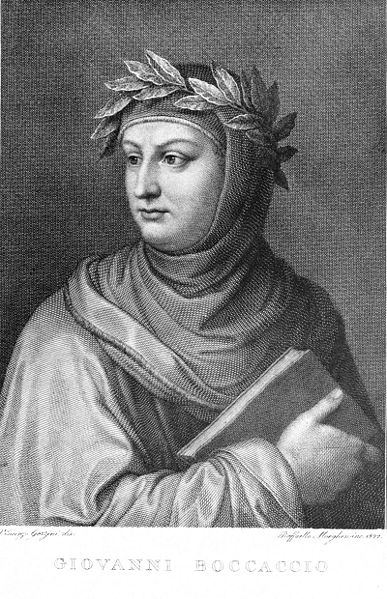
Giovanni Boccaccio (1313-1375), author of the “Decameron, On Famous Women”

The play is based on a tale by the great Florentine author -poet Giovanni Boccaccio (1313-1375) in The Decameron, a collection of one hundred novellas that became the model of Italian prose for writers in the sixteenth century.

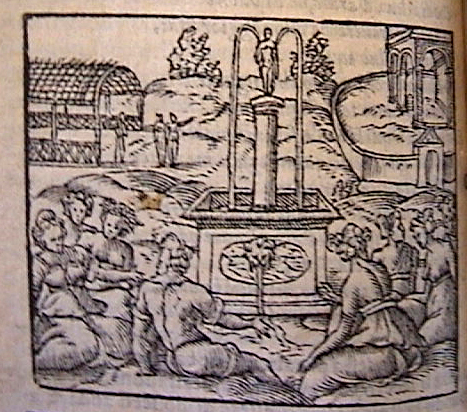
Illustration of the “Decameron”

A now-lost stage work entitled The Historie of the Rape of the Second Helene, recorded as performed at Richmond Palace on 6 January 1579, might have been an early version of All’s Well, which did not appear in print until the 1623 First Folio.

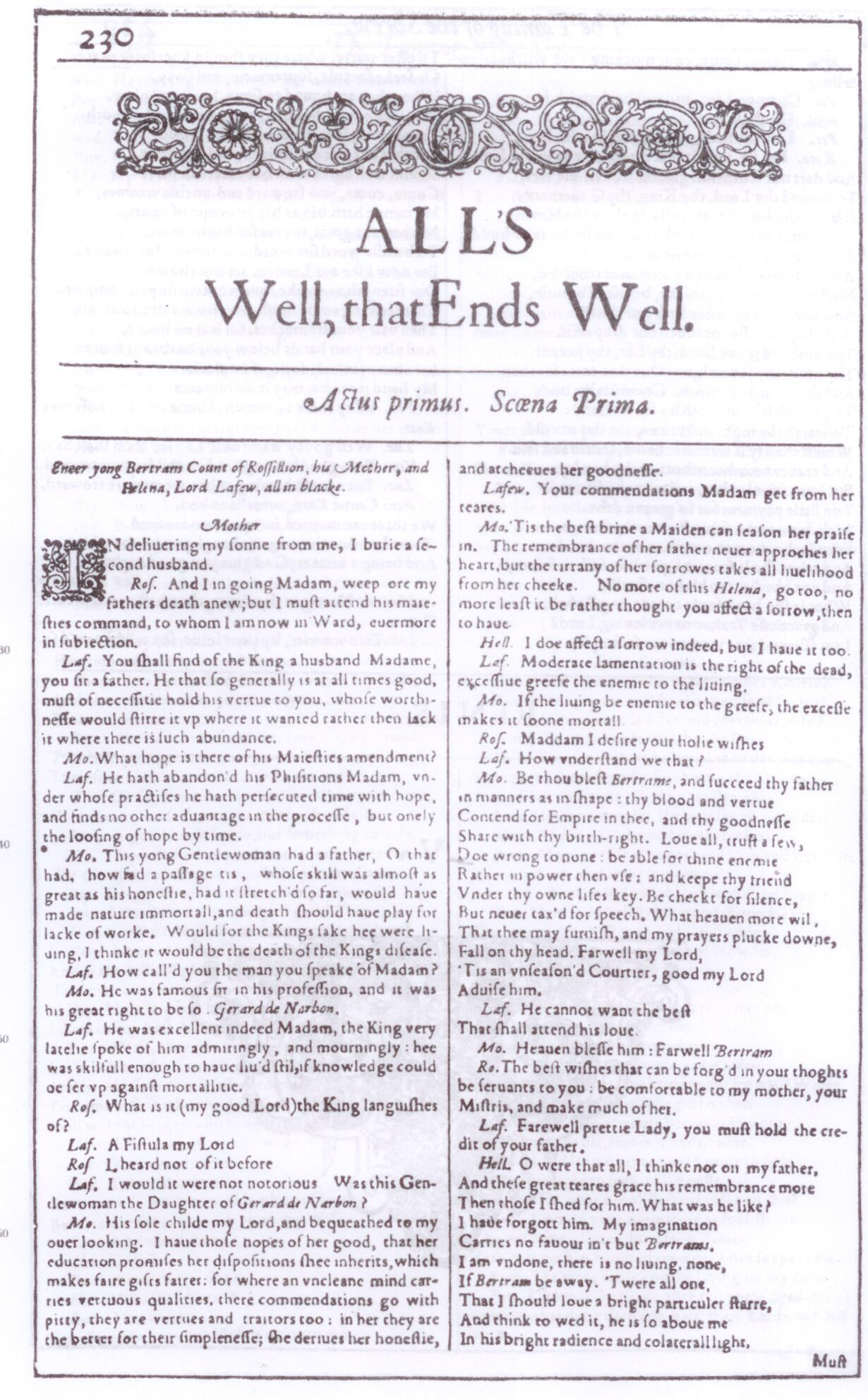
“All’s Well That Ends Well” in the First Folio of 1623

If the play performed at Richmond was in fact an early draft of All’s Well, observes William Farina in De Vere as Shakespeare, “then perhaps the play reflects de Vere coming to grips with his own bad behavior toward his wife, in which case Bertram would represent Shakespeare’s own unvarnished and unflattering self-portrait of the artist as a young man.”

The early version would have been written solely for Queen Elizabeth and members of her royal court, who would have quickly understood its contemporary allusions and inside jests.

A revised version for the public playhouse in the 1590s may have been the “unknown” Shakespeare comedy to which Francis Meres refers in Palladis Tamia (1598) as Love labours Wonne.

[There is no record of a All’s Well being performed until 1741.]

Following are some of the ways in which Bertram appears to reflect Oxford:

ROYAL WARD

When Oxford’s father died he was summoned to London as a ward in subjection to her Majesty the Queen of England. All’s Well begins when, upon his father’s death, young Bertram has been summoned to Paris as a royal ward of the King of France:

Countess: In delivering my son from me I bury a second husband.

Bertram: And I in going, madam, weep o’er my father’s death anew; but I must attend his Majesty’s command, to whom I am evermore in subjection.

A Scene from “All’s Well That Ends Well”

MARRIAGE

When Vere came of age in 1571 a marriage was arranged between him and his guardian William Cecil’s fifteen-year-old daughter, Anne, a commoner.  Bertram is leaving behind the young Helena, a commoner’s daughter who had fallen in love with him:

“I am undone.  There is no living, none, if Bertram be away.  ‘Twere all one that I should love a bright particular star and think to wed it, he is so above me.  In his bright radiance and collateral light must I be comforted, not in his sphere.”

The King promises to elevate Helena’s family to the nobility so she and Bertram can marry.  In real life, Elizabeth raised up her chief minister from commoner status to become Lord Burghley, so that Anne, who had grown up with Oxford in the same household and undoubtedly loved him, would be of the nobility and able to marry him.

MILITARY SERVICE

Oxford, who had served in the 1570 campaign against the rebelling Catholic earls of the north, nonetheless hungered for more military service but had been kept behind for being too young.  In the fall of 1572, after the St. Bartholomew’s Day Massacre [of Protestants] in France, he begged Burghley to allow him to serve on a ship or abroad “where yet some honor were to be got,” adding he was also “most willing to be employed on the sea coasts, to be in readiness with my countrymen against any invasion.”  He was continually blocked, however, and his complaints are echoed by the Count in the play:

“I am commanded here and kept a coil with ‘Too young’ and ‘The next year’ and ‘’Tis too early’… I shall stay here the forehorse to a smock [a woman’s lead horse], creaking my shoes on the plain masonry [palace floors, instead of rough battlefield], till honor be bought up [exhausted], and no sword worn but one to dance with.  By heaven, I’ll steal away!”

Oxford did “steal away” from England without authorization, in the summer of 1574, but he was forced to return three weeks later.

“The Decameron” by Boccaccio — a hundred stores narrated by seven women and three men during the Plague of 1348

PROMISE

Oxford finally received permission to travel abroad in early 1575 and spent more than fifteen months in France, Germany and Italy, with his home base in Venice.  Back in England, when the earl’s wife revealed she was pregnant, Elizabeth “sprung up from the cushions” and said, “I protest to God that next to them that have interest in it, there is nobody can be more joyous of it than I am!”   A bit later, however, she repeated the promise Oxford had given her “openly in the presence chamber that if she [Anne] were with child, it was not his!” (This is in a letter from Dr. Richard Master, court physician, written to Lord Burghley on March 7, 1575, while Oxford was at the French  court in Paris.)

De Vere had promised the queen that he would not sleep with his wife, just as we find the count saying the same in relation to his wife, Helena:

“Although before the solemn priest I have sworn, I will not bed her … O my Parolles, they have married me!  I’ll go to the Tuscan wars and never bed her … I have wedded, not bedded her, and sworn to make the ‘not’ eternal.”  And writing to Helena: “When thou canst … show me a child begotten of thy body that I am father to, then call me husband; but in such a ‘then’ I write a ‘never.’”

BED TRICK

Bertram fathers a son by means of a “bed trick,” a scheme hatched by Helena whereby another woman goes to bed with him and then, in the dark, Helena trades places with her.  In The Histories of Essex (1836) gossip of similar details is recorded about Oxford, Anne and her father:

“[Oxford] forsook his lady’s bed, [but] the father of Lady Anne by stratagem contrived that her husband should unknowingly sleep with her, believing her to be another woman, and she bore a son to him in consequence of this meeting.” [Anne gave birth to a girl, Elizabeth Vere, in 1575.]

Also the Master of the Horse to Philip Herbert, Earl of Montgomery [who married Oxford’s youngest daughter, Susan], refers in a memoir to “the last great Earl of Oxford, whose lady was brought to his bed under the notion of his mistress, and from such a virtuous deceit she [Susan] is said to proceed.”  [Again, the child was Elizabeth Vere.]

The bed trick also appears in Measure for Measure.

All’s Well includes a backdrop of the wars in the Netherlands between Spain and the Dutch in the 1570s, along with what Farina describes as “enormous amounts of esoteric knowledge regarding the history and geography of France and Italy, as well as Renaissance literature and courtly social customs” — a further link in the chain of evidence pointing to Oxford as the author.

Another source of the play is William Painter’s English translation of Decameron, published in 1566, when de Vere was sixteen and graduating from Oxford University. The earl knew Italian and undoubtedly also read Decameron in its original language, which “Shakespeare” appears to have done — although traditional scholars have been unable to explain how the Stratford man could have read the Italian version.

[This post is No. 73 in 100 Reasons Shakes-peare was the Earl of Oxford]

The Art of English Poetry: Re-Posting Reason 15 Why Shake-speare was the Earl of Oxford

Edward de Vere received a prominent place in an anonymous work The Arte of English Poesie (1589), regarded as the central text of Elizabethan courtly politics. His position in the world of letters had already been stated unequivocally in 1586, when William Webbe declared in A Discourse of English Poetry:

“The Arte of English Poesie” – 1589

“I may not omit the deserved commendations of many honourable and noble Lords and Gentlemen in Her Majesty’s Court, which, in the rare devices of poetry have been, and yet are, most skillful; among whom the Right Honourable Earl of Oxford may challenge to himself the title of the most excellent among the rest.”

Now, three years later in 1589, another overview (this one by an unnamed author) is published by Richard Field, formerly of Stratford-upon-Avon and a Protestant printer close to William Cecil Lord Burghley. Field will issue Venus and Adonis of 1593 and Lucrece of 1594, both dedicated by “William Shakespeare” to Henry Wriothesley, Earl of Southampton. Modern scholars have attributed The Arte to George Puttenham, but others believe the author was Oxford’s friend Lord John Lumley; Richard M. Waugaman has set forth a case for Oxford’s own authorship.  [See Brief Chronicles, the online journal of the Shakespeare Fellowship, and Waugaman’s own online site The Oxfreudian.]

Partly the book may represent Oxford’s “eloquent pleading for the Queen’s commission for his writing the pro-Tudor ‘Shakespeare’ history plays,” Waugaman suggests, noting it “champions the persuasive power of poesy historical, while emphasizing that it [poetry or drama] is all the more instructive if it is not slavishly factual.”

The Arte is dedicated to Burghley, Oxford’s father-in-law and former guardian, but it’s actually addressed to Elizabeth herself. It emphasizes the importance of deception, disguise and anonymity.  The unnamed author says that many members of the nobility or gentry “have no courage to write & if they have, yet are they loath to be a known of their skill.  So as I know very many notable Gentlemen in the Court that have written commendably, and suppressed it again, or else suffered it to be published without their own names to it: as if it were a discredit for a Gentleman to seem learned and to show himself amorous of any good Art.”

A page from “The Arte” showing the Elizabethans’ interest in structure, form, shape, architectural form and so on

He proceeds to name names: “And in her Majesty’s time that now is are sprung up another crew of Courtly makers, Noble men and Gentlemen of her Majesty’s own servants, who have written excellently well as it would appear if their doings could be found out and made public with the rest, of which number is first that noble Gentleman Edward Earle of Oxford, Thomas Lord of Bukhurst, when he was young, Henry Lord Paget, Sir Philip Sidney, Sir Walter Raleigh, Master Edward Dyer, Master Fulke Greville, Gascoigne, Britton, Turberville and a great many other learned Gentlemen, whose names I do not omit for envy, but to avoid tediousness, and who have deserved no little commendation.”

The author of Arte knew he was putting a spotlight on Oxford and his literary work. Moreover, on the very next page the anonymous author of The Arte names just a few playwrights: “For Tragedy Lord Buckhurst and Master Edward Ferrys do deserve the highest praise: the Earl of Oxford and Master Edwards of Her Majesty’s Chapel for Comedy and Enterlude.”

[Edwards had been in charge of the Children of the Chapel from 1561 until he died in 1566, a period when Oxford {age eleven to sixteen} was studying with private tutors and receiving honorary degrees from Cambridge and Oxford.  Edwards is credited with writing two plays:  Damon and Pithias, the first English “tragical comedy,” set in the court of Dionysius and performed for Elizabeth’s court in 1565; and Palamon and Arcyte, a “lost” play based on Chaucer’s A Knight’s Tale — and regarded as a possible source for The Two Noble Kinsman attributed to Shakespeare and Fletcher — performed for the Queen at Oxford in 1566.

[A decade later several poems by Oxford appeared in The Paradise of Dainty Devices, an anthology that claims Edwards had compiled it before his death in 1566 – in which case, if true, it’s possible that Oxford’s poems were written no later than his sixteenth year; although he could have added to them any time up to 1576, since he himself probably caused the anthology to be published].

An excerpt of one of Oxford’s poems from Paradise was reprinted in Arte of 1589, wherein the anonymous author wrote: “Edward, Earl of Oxford, a most noble and learned gentleman, made in this figure of response an emblem of Desire, otherwise called Cupid, which for excellency and wit I set down some of the verses” — using the following example of an Oxford poem, in the form of a dialogue:

When wert thou born desire?

In pomp and prime of May,

By whom sweet boy wert thou begot?

By good conceit men say,

Tell me who was thy nurse?

Fresh youth in sugared joy.

What was thy meat and daily food?

Sad sighs with great annoy.

What hadst thou then to drink?

Unfeigned lovers tears.

What cradle wert thou rocked in?

In hope devoid of fears.

Arte speaks of a poet as a “dissembler” motivated by “a secret intent not appearing by the words.” The author offers the example of four lines referring to Queen Elizabeth – not by name, but in words that “any simple judgment might easily perceive” to be referring to her:

Elizabeth I of England

When Princes serve, and Realms obey,

And greatest of Britain kings begot:

She came abroad even yesterday,

When such as saw her knew her not.

It was common practice to write on two levels at once:

“And the rest followeth, meaning her Majesty’s person, which we would seem to hide leaving her name unspoken, to the intent the reader should guess at it: nevertheless upon the matter did so manifestly disclose it, as any simple judgment might easily perceive by whom it was meant, that is by Lady Elizabeth, Queen of England and daughter to King Henry the Eighth, and therein resteth the dissimulation.”

In this same year of 1589 Richard Field would also publish the second edition of the English translation of Ovid’s Metamorphoses, credited in 1567 to Oxford’s uncle Arthur Golding. Here at the end of the tumultuous decade of the 1580s, Oxford was about to leave public life and become something of a recluse. Was he using Field’s press to make a final appearance as an identified poet?  Was he withdrawing from the world while preparing to use the same publisher-printer under the “Shakespeare” just four years later?

[This post has become No. 29 of 100 Reasons Shake-speare was the Earl of Oxford]

… “The World’s Hopeful Expectation” … “The Hope and Expectation of Thy Time” … “The Expectation of the World”

“When Parliament convened in February 1593, the queen was fifty-nine years old, her age intensifying public concern over that ‘uncertain certainty,’ the as-yet-unsettled succession on her death … Despite, or rather because of, the decisive importance of this question, it remained largely invisible on the landscape of public discourse. Elizabeth’s government was determined to see that this preoccupation had no outlet. Public discussion of the succession was forbidden, declared treason by parliamentary statute … The aim of the Crown’s policy was wholly to remove the question of royal lineage from discussion by subjects…” – Robert Lane, The University of North Carolina Press *

Henry Wriothesley
3rd Earl of Southampton

Such was the situation in 1593 when “William Shakespeare” appeared for the first time as the printed signature on the dedication of Venus and Adonis to Henry Wriothesely, Earl of Southampton, to whom he wrote:

“I leave it to your Honourable survey, and your Honour to your heart’s content, which I wish may always answer your own wish, and the world’s hopeful expectation.” **

The same poet would use a variation of “the world’s hopeful expectation” in his play of royal history Henry IV, Part 1, when the King chastises his wayward son, Prince Hal, for wasting his gift of blood and failing to prepare for his kingship:

The hope and expectation of thy time is ruined, and the soul of every man prophetically do forethink thy fall.” (3.2.36-38]

By pointing to “the world’s hopeful expectation” for Henry Wriothesley, the poet was consciously and deliberately proclaiming him as the long-hoped-for successor to Elizabeth, who was adamant in refusing to name anyone to follow her on the throne. “Shakespeare” had carefully selected those words, both to address the young earl directly and to publicly advertise this solution to the nation’s crisis. He was voicing his own hope for Southampton to be named the future Henry IX of England.

Robert Lane observes that a major weapon against the Crown’s suppression of public discussion was the power wielded by Elizabethan writers. Plays, for example, “provided a forum for examination of the issue in a manner sufficiently oblique to avoid government retaliation.” Lane then proceeds to focus on how Shakespeare in his history play King John “thoroughly, almost systematically” engages “the specific issues entailed in the succession crisis of the 1590s.”

Yes — and this same “Shakespeare” – Edward de Vere, Earl of Oxford – was so concerned about the crisis that he used the launch of his new pen name to voice his own “hopeful expectation” for Southampton as a prince. Here was Oxford’s answer to avoiding civil war over the crown; to preventing a foreigner from gaining the throne; and to finally ending the inherent danger to England caused by the Virgin Queen’s silence.

In Part 2 of Henry IV, after Prince Hal becomes King Henry V, he admits the public had viewed him as a wastrel unworthy of the Crown; but now he vows to wipe away that negative “expectation of the world” and fulfill his destiny as a great monarch:

My father is gone wild into his grave,

For in his tomb lie my affections,

And with his spirit sadly I survive

To mock the expectation of the world,

To frustrate prophecies and to raze out

Rotten opinion, who hath writ me down

After my seeming. The tide of blood in me

Hath proudly flowed in vanity till now.

Now doth it turn and ebb back to the sea,

Where it shall mingle with the state of floods

And flow henceforth in formal majesty. (5.2.123-133)

In my view, Oxford dearly hoped that in the future Henry Wriothesley would use similar words, expressing similar sentiments, about “the tide of blood” that flowed in him.

///

x “‘The sequence of posterity’: Shakespeare’s King John and the Succession Controversy” by Robert Lane, The University of North Carolina Press, 1995

xx My emphases

Re-Posting Number 12 of 100 Reasons Why Shake-speare was the Earl of Oxford: The Queen’s Men

PART ONE

In 1583, as Philip of Spain prepared to invade and conquer England, the British government created a new acting company as part of secret service activities, which included wartime propaganda to promote patriotic loyalty and unity.  This new troupe, the Queen Majesty’s Players or Queen Elizabeth’s Men, was formed at the express command of the monarch.  Drawing the best actors from existing companies, it became the dominant theatrical group in the crucial years leading to England’s victory in 1588 over the Spanish Armada.

Although printed in 1594, “The True Tragedy of Richard the Third” was performed by the Queen’s Men in the 1580’s. Did “Shakespeare” steal it for his play “Richard III”? Or was the real author, Edward de Vere, building upon his own previous work?

The Queen’s Men performed what were, by all appearances, early versions of royal history plays published later as by Shakespeare.  “The plots of no fewer than six of Shakespeare’s known plays are closely related to the plots of plays performed by the Queen’s Men,” Scott McMillin and Sally-Beth MacLean write inThe Queen’s Men and their Plays (1998).

Did “Shakespeare” use this early anonymous play for “1 Henry IV,” “2 Henry IV” and “Henry V” Or was “The Famous Victories of Henry the Fifth” his own youthful play?

These histories include The Troublesome Reign of King John (repeated by Shakespeare “virtually scene for scene” in the Shakespeare play King John)The True Tragedy of Richard III and King Leir (fully covered by Shakespeare in his Richard III and King Lear); and also The Famous Victories of Henry the Fifth, which forms the entire foundation for the material in 1 Henry IV, 2 Henry IV and Henry V.

There is no evidence that Shakspere of Stratford was a member of this prestigious acting company.  The likelihood is that he was still in Warwickshire for the birth of his twins in February 1585, when he was twenty years old. By tradition, the “Lost Years” of that man begin in 1585 and continue until Robert Greene supposedly alludes to him in September 1592.  By then, for the legendary story to be plausible, he has somehow firmly established himself in London as an actor and as a promising, even prominent playwright able to provoke Greene’s jealousy.

None of this has any factual basis.

“Documentary evidence as to Shakespeare’s whereabouts and activities from 1585 to 1592 is totally lacking,” Oscar Campbell writes in The Reader’s Encyclopedia of Shakespeare (1966), adding that “nothing can be confirmed” about the Stratford man’s life in that period. Traditional biographers cannot plausibly explain how “Shakespeare” was anonymously writing early versions of his plays for Her Majesty’s company in the 1580’s. Therefore, some suggest he must have joined the Queen’s Men as an actor and memorized the anonymous plays, which were written by others; then, they propose, he drew upon his prodigious memory to plunder their plots, characters, scenes and even lines, which would mean the greatest writer of the English language was also the most successful plagiarist in history.

“The True Chronicle History of King Leir” was performed by the Queen’s Men in the 1580’s (but published in 1605) and transformed by “Shakespeare” into “King Lear”

As a mature dramatist in the 1590s, McMillin and MacLean declare, Shakespeare set about “rewriting a sizeable portion” of the repertory of the Queen’s Men.   “Four of nine extant plays were turned into six Shakespeare plays, in an act of appropriation extensive enough to make us think it could have occurred from the inside.” Such is the kind of deduction that can come from an incorrect premise. “Shakespeare knew the plays of this company better than those of any company but his own, and the long-standing speculation that he may have begun his career with the Queen’s Men seems to us the most likely possibility.”

“The Case for Shakespeare’s Authorship of ‘The Famous Victories'” by Dr. Seymour M. Pitcher, 1961

A few scholars have bravely stated the more realistic conclusion that Shakespeare himself must have written those earlier versions of his own plays, despite the fact that such a claim would rule out the Stratford man.  It requires Shakspere to have joined the Crown’s prestigious acting company too early to fit his biographical time frame. Fresh from life in the market town ninety miles from London, only twenty years old in 1584, he turns out plays of English royal history about monarchs such as King John, Richard III, Henry IV and Henry V — a miraculous example of pulling one self up by the bootstraps if there ever was one.

(In 1961, for example, Dr. Seymour M. Pitcher at Harpur College in New York published an impressively argued book The Case for Shakespeare’s Authorship of “The Famous Victories of Henry the Fifth” — referring to an early play that’s a veritable blueprint for Shakespeare’s later trilogy about Prince Hal becoming Henry the Fifth.   Every scene of Famous Victories is repeated (and in the same order) by Shakespeare, who, Pitcher argued, must have written it when just “a spirited and genial apprentice dramatist.”)

Evidence within The True Tragedy of Richard the Third “reveals the high probability that it was Shakespeare himself who wrote that anonymous play,” argues Ramon Jimenez, “and that his Richard III was his major revision of one of his earliest attempts at playwriting.” There are also “significant links” between the anonymous play and de Vere that “add to the evidence that he was the actual author of the Shakespeare canon.” Furthermore, Jimenez states, the evidence suggests that the anonymous play “was performed for an aristocratic audience, possibly including Queen Elizabeth herself, in the early 1560’s, when de Vere was between thirteen and fifteen years old.”

The scholar Ramon Jimenez, speaking at an authorship conference on the Campus of Concordia University in Portland OR

PART TWO

Oxford was thirty-three in 1583, when Elizabeth’s company was formed by the direct order of Walsingham, head of the government’s intelligence operations, just as the war between England and Spain was becoming official.  During the next crucial years, leading up to the victory over Philip’s Armada in 1588, the new company would perform at court in winter and divide into two traveling troupes in summer.  With its actors wearing the queen’s livery, the wartime company staged dozens of anonymous plays of English royal history throughout the country to promote patriotic loyalty and unity.

During the 1580s, the Queen’s Men performed  works that “Shakespeare” would later turn into mature plays. Moreover, the record shows that Oxford his secretary Lyly were connected to Elizabeth’s  from the outset.   These two facts provide strong evidence that the author of the earlier works performed by the Queen’s Men was Oxford himself, and that it was he who revised his own previous plays for which”Shakespeare” would get the credit.

“The True Chronicle History of King Leir” — acted by the Queen’s Men in the 1580’s, published in 1605, and the principal source of Shakespeare’s “King Lear”

Oxford had returned from  Italy in 1576 and it appears he proceeded to write plays brought to the royal court by the Children of St. Paul’s and by his great friend and supporter Thomas Radcliffe, 3rd Earl of Sussex.  Oxford had served with him in the military campaign of 1570, against the northern Catholic earls in rebellion against the Protestant rule of Elizabeth.  Sussex was now Lord Chamberlain of the Queen’s Household and patron of the first Lord  Chamberlain’s acting company.  Two examples:

* On New Year’s Day 1577 at Hampton Court the Paul’s Boys performed “The historie of Error,” which may well be an early version of The Comedy of Errors. 

* in Febrary 1577 at Whitehall Palace the Lord Chamberlain’s Men performed “The Historie of the Solitarie Knight,” likely an early version of Timon of Athens.

In addition to his patronage of writers, Lord Oxford now had charge of two acting companies, one (Oxford’s Men) of adults and the other (Oxford’s Boys) of choir boys from both Her Majesty’s Children and Paul’s Boys. He had the full sanction of the government; in the mid-1580s, for example, Burghley and Sussex recommended to Cambridge University that Oxford’s Men be allowed to “show their cunning in several plays already practiced by them before the Queen’s Majesty.”

Moreover, Oxford saved the private Blackfriars playhouse from extinction by paying for the lease.  This venue was frequented by aristocrats and students, its performances functioning as rehearsals for appearances in front of Elizabeth at court. Then he passed the lease on to Lyly, who acted as director-manager.  So Oxford was now at the center — he was the center — of the new awakening of English drama leading to “Shakespeare” in the next decade.

Thomas Radcliffe, 3rd Earl of Sussex (1526-1583), Oxford’s friend and surrogate father, whose Lord Chamberlain’s Men brought plays to Court until his death

Sussex was near death when the order came down on 10 March 1583 to Edmund Tilney, Master of the Revels, that her Majesty’s new acting company be formed.  In effect the Queen’s Men would replace the Chamberlain’s Men. Assigned to assemble the personnel was Walsingham, who had no personal interest in the theatre, but was nonetheless quite aware of its persuasive power.

The formation of the Queen’s Men signaled a new awareness by the Privy Council of the potential for combining theatrical activity and espionage, since players frequently traveled, nationally and internationally. This new adult company could serve the Crown in multiple ways, such as collecting information useful to Walsingham’s intelligence network.

The spymaster assembled the Queen’s Men by enlisting the dozen best performers from all the existing companies.  These included the Dutton brothers, leading players of Oxford’s Men; and the popular clown Richard Tarlton, taken from Sussex’s troupe, who quickly became the star of Elizabeth’s Men.

“The new Queen’s Company made its first appearance at the beginning of the Court season on December 26, 1583,” Ward reports in The Seventeenth Earl of Oxford from Contemporary Documents (1928).  “On Jan. 1, 1584 a performance was given  by Oxford’s Men; and as John Lyly appears in the Chamber Accounts as payee for the company on that date, there is every reason to believe that the play acted was Lyly’s Campaspe.  On March 8, 1584 both Oxford’s and the Queen’s Men performed; once again Lyly was payee for Oxford’s Men …

“Now, it seems unreasonable to suppose that two plays were presented on this day; the most likely solution, therefore, would be that the two companies [Oxford’s and the Queen’s] were amalgamated and rehearsed by Lord Oxford’s private secretary John Lyly, the author of the play.  No other adult companies besides these two appeared at Court during this season.”

Oxford was positioned to respond to the Crown’s need for patriotic plays of English royal history, and, too, he was involved in the creation and operation of the Queen’s Men, whose adult professional actors performed anonymous plays that “Shakespeare” would transform into masterpieces.

Note: This post is now No. 42 of 100 Reasons Shake-speare was the Earl of Oxford.  

“Shakespeare Confidential” — The New Book by C.V. “Chuck” Berney

This is a gem of a book filled with sparkling jewels of new insight and new information — for Shakespeare lovers of any kind.  Chuck Berney has been a leader in the field of Shakespearean authorship and of the Oxfordian movement for many years, but he is also, by nature and experience, beyond and above such labels or definitions.  A veteran of the U.S. Army and a Doctor of Physical Chemistry, here is a man of scientific background and large, intuitive vision, one who writes much in the way he speaks — directly, personally, honestly, amusingly, as he continually surprises.

Shakespeare Confidential brings together Berney’s many pieces of writing over the years, starting with ten short essays on film versions of various Shakespeare plays, immediately followed by wonderful pieces such as “Legend of the Round-Earthers” and “Six Reasons Why Stratfordian ‘Scholarship’ is Bad.”  And there’s much, much more — from Walter Scott to “The Spanish Tragedy” to Robert Dudley, Earl of Leicester (“Portrait of a Serial Killer?”) to other topics including one on “Billy Budd and The Monument,” referring to a relationship between Herman Melville’s nineteenth-century novel and my book about Shakespeare’s sonnets. Berney makes a strong and perceptive case that Melville was depicting Edward de Vere the seventeenth earl of Oxford as “Captain Edward Vere” and Henry Wriothesley the third earl of Southampton as the young, handsome sailor Billy Budd, who is accused of helping to lead a mutinous plot, much as Southampton was accused of co-leading the Essex Rebellion of 1601 against the government.

Highly recommended!


Re-Posting Reason 11: Oxford’s Prefatory Letter for “Cardanus Comforte” of 1573

(Note: Below is a re-posting of all three parts of Reason 11 much as they originally appeared on this blog site. The combination of all three parts accounts for the length of this single post.  The same entry, reduced in length, now appears as Reason 25 in 100 Reasons Shake-speare was the Earl of Oxford.

When J. Thomas Looney hypothesized that Edward de Vere earl of Oxford was “Shakespeare,” he came upon his prefatory letter for Thomas Beddingfield’s translation of Cardanus Comforte published in 1573, when Oxford was twenty-three, and one can only imagine Looney’s amazement upon finding such self-evident support for his thesis.  After all, here was a letter we might well have expected to find from “Shakespeare” as a young man.

“CARDANUS Comforte, translated And Published by commaundement of the right Honourable the Earle of Oxenforde.” This is the 1576 edition; the first was in 1573.

Looney wrote in “Shakespeare” Identified (1920) that Oxford’s letter “gives us a glimpse into the nature of the man himself as he was in these early years.  Whatever may have been the pose he thought fit to adopt in dealing with some of the men about Elizabeth’s court, this letter bears ample testimony to the generosity and largeness of his disposition, the clearness and sobriety of his judgment, and the essential manliness of his actions and bearing towards literary men whom he considered worthy of encouragement…

“As a letter it is, of course, prose, but it is the prose of a genuine poet: its terse ingenuity, wealth of figurative speech, and even its musical quality…”

Oxford had taken the court by storm; an expert in horsemanship, he was the new champion of the Whitehall tiltyard; and already he had risen to the heights of the royal favor, amid gossip that he and the queen were lovers despite his marriage to the daughter of chief minister William Cecil, Lord Burghley, the most powerful man in England. In addition, breaking with tradition as he had done with sponsorship of The Courtier by Castiglione, the young earl was clearly England’s great champion of literature and the Italian renaissance.

John Thomas Looney (1870-1944)

Looney’s parting word on the Cardanus preface was a plea to his readers to “familiarize themselves thoroughly with the diction of this letter” and then “read the dedication of Venus and Adonis” to Southampton printed in 1593: “So similar is the style that it is hardly necessary to make any allowance for the [twenty] intervening years.”

An Oxfordian who picked up on the latter theme was Joseph Sobran (1946-2010), who, in the appendix section of Alias Shakespeare (1997), offered perceptive observations such as:

“This document unmistakably prefigures the Southampton poems of Shakespeare: the Sonnets, Venus and Adonis, and The Rape of Lucrece. Written when Oxford was only twenty-three, the letter anticipates these poems in spirit, theme, image, and other details. Like those poems, it borrows, for figurative use, the languages of law, commerce, horticulture, and medicine. It speaks of publication as a duty and of literary works as tombs and monuments to their authors. It has echoes in the plays, and the points of resemblance to the Southampton poems are especially notable…

“Alias, Shakespeare” (1997) by Joseph Sobran

“Oxford’s letter is Shakespearean in a wider respect too: in its overwhelming warmth and generosity, verging on excess, yet controlled by a pleasant irony. He loves to praise, but he avoids the risk of fulsomeness by disguising praise as admiring accusation. ‘For shame!’ he says: ‘You want to hoard your own excellence, deny your virtue to the world!’  This is exactly the rhetorical strategy of Sonnets 1 through 17, using much the same language and many of the same images…”

Here is Oxford’s public letter in 1573 to Bedingfield in full, followed by the dedication of Venus and Adonis in 1593 to Henry Wriothesley, third earl of Southampton:

“To my loving friend Thomas Bedingfield Esquire, one of Her Majesty’s gentlemen pensioners.

“After I had perused your letters, good Master Bedingfield, finding in them your request far differing from the desert of your labor, I could not choose but greatly doubt whether it were better for me to yield you your desire, or execute mine own intention towards the publishing of your book. For I do confess the affections that I have always borne towards you could move me not a little. But when I had thoroughly considered in my mind of sundry and divers arguments, whether it were best to obey mine affections or the merits of your studies, at the length I determined it better to deny your unlawful request than to grant or condescend to the concealment of so worthy a work. Whereby as you have been profited in the translating, so many may reap knowledge by the reading of the same, that shall comfort the afflicted, confirm the doubtful, encourage the coward, and lift up the base-minded man, to achieve to any true sum or grade of virtue, whereto ought only the noble thoughts of men to be inclined.

“And because next to the sacred letters of divinity, nothing doth persuade the same more than philosophy, of which your book is plentifully stored, I thought myself to commit an unpardonable error, to have murdered the same in the waste bottoms of my chests and better I thought it were to displease one than to displease many: further considering so little a trifle cannot procure so great a breach of our amity, as may not with a little persuasion of reason be repaired again. And herein I am forced like a good and politic captain oftentimes to spoil and burn the corn of his own country lest his enemies thereof do take advantage. For rather than so many of your countrymen should be deluded through my sinister means of your industry in studies (whereof you are bound in conscience to yield them an account) I am content to make spoil and havoc of your request, and that, that might have wrought greatly in me in this former respect, utterly to be of no effect or operation: and when you examine yourself what doth avail a mass of gold to be continually imprisoned in your bags, and never to be employed to your use? I do not doubt even so you think of your studies and delightful Muses. What do they avail, if you do not participate them to others? Wherefore we have this Latin proverb: Scire tuum nihil est, nisi te scire hoc sciat alter. What doth avail the tree unless it yield fruit unto another? What doth avail the vine unless another delighteth in the grape? What doth avail the rose unless another took pleasure in the smell?  Why should this tree be accounted better than that tree, but for the goodness of his fruit? Why should this vine be better than that vine, unless it brought forth a better grape than the other? Why should this rose be better esteemed than that rose, unless in pleasantness of smell it far surpassed the other rose?

“And so it is in all other things as well as in man. Why should this man be more esteemed than that man, but for his virtue, through which every man desireth to be accounted of?  Then you amongst men I do not doubt, but will aspire to follow that virtuous path, to illuster yourself with the ornament of virtue.  And in mine opinion as it beautifieth a fair woman to be decked with pearls and precious stones, so much more it ornifieth a gentleman to be furnished in mind with glittering virtues.

“Wherefore considering the small harm I do to you, the great good I do to others, I prefer mine own intention to discover your volume before your request to secret the same; wherein I may seem to you to play the part of the cunning and expert mediciner or physician, who, although his patient in the extremity of his burning fever is desirous of cold liquor or drink to qualify his sore thirst, or rather kill his languishing body, yet for the danger he doth evidently know by his science to ensue, denieth him the same. So you being sick of too much doubt in your own proceedings, through which infirmity you are desirous to bury and insevill your works in the grave of oblivion, yet I, knowing the discommodities that shall redound to yourself thereby (and which is more, unto your countrymen) as one that is willing to salve so great an inconvenience, am nothing dainty to deny your request.

“Again, we see if our friends be dead, we cannot show or declare our affection more than by erecting them of tombs; whereby when they be dead indeed, yet make we them live as it were again through their monument; but with me, behold, it happeneth far better, for in your lifetime I shall erect you such a monument, that as I say [in] your lifetime you shall see how noble a shadow of your virtuous life shall hereafter remain when you are dead and gone. And in your lifetime, again I say, I shall give you that monument and remembrance of your life, whereby I may declare my good will, though with your ill will as yet that I do bear you in your life.

“Thus earnestly desiring you in this one request of mine (as I would yield to you in a great many) not to repugn the setting-forth of your own proper studies, I bid you farewell. From my new country muses at Wivenghole, wishing you as you have begun, to proceed in these virtuous actions. For when all things shall else forsake us, virtue yet will ever abide with us, and when our bodies fall into the bowels of the earth, yet that shall mount with our minds into the highest heavens.

“By your loving and assured friend, E. Oxenford”

DEDICATION OF “VENUS AND ADONIS” – 1593:

“TO THE RIGHT HONORABLE Henry Wriothesley, Earle of Southampton, And Baron of Tichfield

“Right Honourable,

“I know not how I shall offend in dedicating my unpolished lines to your Lordship, nor how the world will censure me for choosing so strong a prop to support so weak a burden.  Only, if your Honour seem but pleased, I account my self highly praised, and vow to take advantage of all idle hours, till I have honoured you with some graver labour.  But if the first heir of my invention prove deformed, I shall be sorry it had so noble a godfather: and never after ear so barren a land, for fear it yield me still so bad a harvest.  I leave it to your Honourable survey, and your Honour to your heart’s content, which I wish may always answer your own wish, and the world’s hopeful expectation.

“Your Honors in all duty, William Shakespeare”

///

The Oxford Universal Dictionary cites “Shakespeare” as the first person to write “persuade” and “murdered” as he used those words here:

“… your king … sends me a paper to persuade me patience?” – 3 Henry VI

“’Glamis hath murdered sleep…’” – Macbeth  

But Edward de Vere Earl of Oxford had used “persuade” and “murdered” in those same ways much earlier, when he was twenty-three, within his dedicatory letter to the translator of Cardanus Comforte:

“And because next to the sacred letters of divinity, nothing doth persuade the same more than philosophy, of which your book is plentifully stored, I thought myself to commit an unpardonable error to have murdered the same in the waste bottoms of my chests.”

“The Mysterious William Shakespeare” (1984, 1992) by Charlton Ogburn Jr.

Charlton Ogburn Jr. reported these findings in The Mysterious William Shakespeare (1984), supporting the theory that Oxford himself was the author of 3 Henry VI and Macbeth, in which case he was simply using “persuade” and “murdered” as he had done years before.   Centuries later “Shakespeare” would be credited with creating those word usages without anyone noticing that in fact it was de Vere.

The above is just one small example of what will be discovered (and re-discovered) once Oxford and “Shakespeare” are recognized as one and the same man.

////

William Plumer Fowler’s magnum opus,  Shakespeare Revealed in Oxford’s Letters (1986), will one day be recognized as a major contribution to studies of Shakespearean authorship; and most of the examples cited below are taken from that important work of 872 pages.

Shakespeare Revealed in Oxford’s Letters (1986) by William Plumer Fowler

Following is the first paragraph of Oxford’s prefatory dedication addressed “To my loving friend Thomas Bedingfield Esquire, one of Her Majesty’s gentlemen pensioners.”   I have underlined words and phrases that will appear in the plays, poems and sonnets to be published under the “Shakespeare” name two or three decades after 1573:

After I had perused your letters, good Master Bedingfield, finding in them your request far differing from the desert of your labor, I could not choose but greatly doubt whether it were better for me to yield you your desire, or execute mine own intention towards the publishing of your book. For I do confess the affections that I have always borne towards you could move me not a little. But when I had thoroughly considered in my mind of sundry and divers arguments, whether it were best to obey mine affections or the merits of your studies, at the length I determined it better to deny your unlawful request than to grant or condescend to the concealment of so worthy a work. Whereby as you have been profited in the translating, so many may reap knowledge by the reading of the same, that shall comfort the afflicted, confirm the doubtful, encourage the coward, and lift up the base-minded man, to achieve to any true sum or grade of virtue, whereto ought only the noble thoughts of men to be inclined.

Oxford: “After I had perused your letters, good Master Bedingfield…”

Shakespeare: “Have you perused the letters from the pope” – 1 Henry VI, 5.1.1

Oxford: “…finding in them your request far differing from the desert of your labor, I could not choose but greatly doubt…”

Shakespeare: “I cannot choose but pity her” – The Two Gentlemen of Verona, 4.4.77

Oxford: “… whether it were better for me to yield you your desire, or execute mine own intention towards the publishing of your book.”

Shakespeare: “I’ll force thee to yield to my desire” – The Two Gentlemen of Verona, 5.4.59

Shakespeare: “We’ll execute your purpose” – Troilus and Cressida, 3.3.50

Shakespeare (Following the same sentence construction used above by Oxford): “Whether ‘tis nobler in the mind to suffer the slings and arrows of outrageous fortune, or to take arms against a sea of troubles” – Hamlet, 3.1.55

Oxford: “For I do confess the affections that I have always borne towards you could move me not a little.”

Shakespeare: “For Polixenes, with who I am accused, I do confess” – The Winter’s Tale, 3.2.62

Shakespeare: “You … have misdemeaned yourself, and not a little” – Henry VIII, 5.3.14

Oxford: “But when I had thoroughly considered in my mind…”

Shakespeare: “My lord, I have considered in my mind” – Richard III, 4.2.83

Oxford: “… of sundry and divers arguments, whether it were best to obey mine affections or the merits of your studies, at the length I determined it better to deny your unlawful request than to grant or condescend to the concealment of so worthy a work.”

Shakespeare: “So you do condescend to help me now” – 1 Henry IV, 5.3.17

Shakespeare: “In strange concealments, valiant as a lion” – 1 Henry IV, 3.1.166

Shakespeare: “A little of that worthy work performed” – Coriolanus, 2.2.45

Oxford: “Whereby as you have been profited in the translating, so many may reap knowledge by the reading of the same…”

Shakespeare: “I profit in the knowledge of myself” – Twelfth Night, 5.1.25

(In the above lines, within a single paragraph, Oxford uses concealment, worthy and profited; and all three are echoed in a single passage of 1 Henry IV, 3.1.164-166: “In faith he is a worthy gentleman, exceedingly well read, and profited in strange concealments.”)

Oxford: “…that shall comfort the afflicted …”

Shakespeare: “For this affliction has a taste as sweet as any cordial comfort” – The Winter’s Tale, 5.3.76


Oxford:  “… confirm the doubtful …”

Shakespeare: “As doubtful whether what I see be true, until confirmed” – The Merchant of Venice, 3.2.148


Oxford: “… encourage the coward, and lift up the base-minded man…”

Shakespeare: “Faith, I’ll bear no base mind” – 2 Henry IV, 3.2.240


Oxford: “… to achieve to any true sum or grade of virtue…”

Shakespeare: “To leave for nothing all thy sum of good” – Sonnet 109, line 12


Oxford: “… whereto ought only the noble thoughts of men to be inclined.”

Shakespeare: “The Doll and Helen of thy noble thoughts is in base durance” – 2 Henry IV, 5.5.36

Here is another section of Oxford’s letter:

I thought myself to commit an unpardonable error, to have murdered the same in the waste bottoms of my chests … further considering so little a trifle cannot procure so great a breach of our amity … and when you examine yourself what doth avail a mass of gold to be continually imprisoned in your bags, and never to be employed to your use … What do they avail, if you do not participate them to others … So you being sick of too much doubt in your own proceedings, through which infirmity you are desirous to bury and insevill your works in the grave of oblivion … “ – Edward de Vere, in his prefatory letter to Bedingfield’s translation of Cardanus Comforte from Italian into English.

Girolamo Cardano (1501-1576) the Italian philosopher and author of “Cardanus Comforte,” was still alive when Oxford was in Italy during 1575-1576

The 23-year-old earl created an elaborate “excuse” for publishing the work despite his friend’s wish that he refrain from doing so.  This apology or justification was not meant to be taken seriously by the readers; rather it was a literary device that Oxford used to create a lofty, amusing piece of writing while introducing Cardano’s work that has come to be known as the book Hamlet carries with him and reads on stage.

What Oxford produced was a piece of Elizabethan prose that Percy Allen described in the 1930’s as “one of the most gracious that even those days of exquisite writing have bequeathed to us, from the hand of a great nobleman … with its friendship that never condescends, its intimacy that is never familiar, its persuasive logic, its harmonious rhythms, its gentle and compelling charm.”  [The Life Story of Edward de Vere as “William Shakespeare” – 1932]

Here is surely the same voice we hear in the Prince of Denmark’s words, Allen noted.  Here is prose that sounds like Hamlet’s speech to the common players who arrive at the palace.  As Delia Bacon had put it in the 19th century, the author of the play must have been quite like “the subtle Hamlet of the university, the courtly Hamlet, ‘the glass of fashion and the mold of form’” – a description that perfectly fits Lord Oxford in the early 1570’s, when he was in the highest royal favor at the Court of Elizabeth.  [The Philosophy of the Plays of Shakspere Unfolded – 1857]

Oxford and “Shakespeare” both argue that the possessor of a talent has a duty to use it, that anyone with a virtue has a responsibility to share it with others rather than hoard it for himself alone.  The earl writes that if he had failed to publish Bedingfield’s translation he would have murdered the same in the waste bottoms of my chests.”  By contrast his act of causing the work to be published is but a “trifle” to be overcome; and from “Shakespeare” we shall hear the same words within the context of the same theme in the sonnets to Henry Wriothesley, 3rd Earl of Southampton:

So the time that keeps you as my chest – Sonnet 52

Shall time’s best jewel from time’s chest lie hid? – Sonnet 65

But thou, to whom my jewels trifles are – Sonnet 48

But beauty’s waste hath in the world an end,

And kept unused the user so destroys it;

No love toward others in that bosom sits

That on himself such murderous shame commits.  – Sonnet 9

Oxford rhetorically asks his friend to consider how it avails “a mass of gold to be continually imprisoned in your bags and never to be employed to your use?”  What good are Bedingfield’s studies if he chooses to “not participate them to others”?  Why would he want to “bury” his works “in the grave of oblivion?”

By new unfolding his imprisoned pride – Sonnet 52

Th’imprisoned absence of your liberty – Sonnet 58


Thou that art now the world’s fresh ornament [“time’s best jewel”]

And only herald to the gaudy spring,

Within thine own bud buriest thy content,

And, tender churl, mak’st waste in niggarding.

Pity the world!  Or else this glutton be:

To eat the world’s due, by the grave and thee – Sonnet 1


In Venus and Adonis of 1593, the goddess Venus lectures young Adonis on the same theme using the same words:

What is thy body but a swallowing grave,

Seeming to bury that posterity

Which by the rights of time thou needs must have,

If thou destroy them not in dark obscurityVenus and Adonis, lines 757-762

Thou art the grave where buried love doth live – Sonnet 31

The Tudor Rose – “That which we call a Rose by any other name would smell as sweet” – Juliet

Oxford enlarges upon his theme:

“What doth avail the tree unless it yield fruit to another … What doth avail the Rose unless another took pleasure in the smell … Why should this Rose be better esteemed than that Rose, unless in pleasantness of smell it far surpassed the other Rose?  And so it is in all other things as well as in man.  Why should this man be more esteemed than that man, but for his virtue through which every man desireth to be accounted of?  Then you amongst men I do not doubt but will aspire to follow that virtuous path, to illuster yourself with the ornaments of virtue…” 

And “Shakespeare” more than two decades later:

What’s in a name?  That which we call a rose

By any other name would smell as sweet

Romeo and Juliet, 2.2.

But flowers distilled, though they with winter meet,

Lose but their show; their substance still smells sweet.

– Sonnet 5

O how much more doth beauty beauteous seem

By that sweet ornament which truth doth give!

The Rose looks fair, but fairer we it deem

For that sweet odor which doth in it live.

The Canker-blooms have full as deep a dye

As the perfumed tincture of the Roses

But for their virtue only is their show,

They live unwoo’d, and unrespected fade,

Die to themselves.  Sweet Roses do not so:

Of their sweet deaths are sweetest odors made.  – Sonnet 54


Oxford writes:

“ … wherein I may seem to you to play the part of the cunning and expert mediciner or Physician, who, though his patient in the extremity of his burning Fever, is desirous of cold liquor or drink to qualify his sore thirst, or rather kill his languishing body …”

And Shakespeare uses the same image:

My love is as a fever longing still

For that which longer nurseth the disease,

Feeding on that which doth preserve the ill,

The uncertain sickly appetite to please:

My reason, the Physician to my love…” – Sonnet 147

And finally, to choose among many such examples, Oxford anticipates one of Shakespeare’s major themes in the Sonnets printed in 1609, the power of his pen to create a “monument” for posterity:

“Again we see if our friends be dead, we cannot show or declare our affection more then by erecting them of Tombs: Whereby when they be dead in deed, yet make we them live as it were again through their monument, but with me behold it happeneth far better, for in your life time I shall erect you such a monument, that as I say in your lifetime you shall see how noble a shadow of your virtuous life shall hereafter remain when you are dead and gone.  And in your life time again I say, I shall give you that monument and remembrance of your life…”

Sonnet 81:

Not marble nor the gilded monuments

Of Princes shall outlive this powerful rhyme,

But you shall shine more bright in these contents

Than unswept stone, besmeared with sluttish time.

When wasteful war shall Statues overturn

And broils root out the work of masonry,

Nor Mars his sword nor war’s quick fire shall burn

The living record of your memory.  

‘Gainst death and all-oblivious enmity

Shall you pace forth!  – Sonnet 55

Your monument shall be my gentle verse,

Which eyes not yet created shall o’er-read,

And tongues to be your being shall rehearse,

When all the breathers of this world are dead.

You still shall live (such virtue hath my pen)

Where breath most breathes, even in the mouths of men.


Sonnet 107, the couplet at the end:

And thou in this shalt find thy monument,

When tyrants’ crests and tombs of brass are spent.